
Preached on the Fourteenth Sunday after Pentecost (Proper 17A), August 30, 2026, at St. Paul’s Episcopal Church, Seattle, Washington by The Reverend Stephen Crippen.
Jeremiah 15:15-21
Psalm 26:1-8
Romans 12:9-21
Matthew 16:21-28
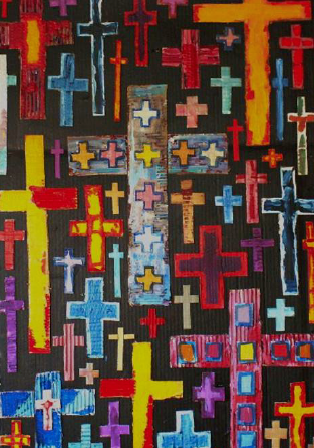
Take Up Your Cross, mixed media collage by John Kohan
“Why aren’t we talking about fascism?”
That’s what someone was asking, over the past few days. I was working near Columbus, Ohio, as one of the trainers for the College for Congregational Development in the Diocese of Southern Ohio.
We covered lots of topics: congregational identity, Episcopal identity, how to map the neighborhood around your church to discern where God is sending you next on your mission, how to look at your congregation through different lenses to see different things — things like where you are on the organizational life cycle. If you’re wondering, St. Paul’s Seattle is currently in the “healthy stability” stage of our organizational life.
We learned a tool to discover who is coming to our congregations to develop their faith, and how best to nurture and lead them; and another tool to discern how the faithful enter their worlds of family, work, neighborhood, and civic life, and what (if anything) they do in those worlds that’s different or better because they said their prayers with us.
“Why aren’t we talking about fascism?” the participant said again. He mentioned this concern in his small group, in our main plenary sessions, and in his written evaluation of the week, which he filled out at the end of our time together. He seemed frustrated because, he reasoned, if we aren’t talking about the crisis of fascism currently threatening not just livelihoods but lives in our nation, a crisis trapping and killing people along the Strait of Hormuz, along our southern border, inside our urban centers and neighborhoods, just outside these doors, everywhere – if we aren’t talking about this global calamity, then, this participant said, we are blessing the status quo. We are going along with all the outrageous things that are happening. We are part of the problem.
He may as well have listened to all of our presentations about congregational development and all things church, and then said, “Get behind me, Satan! You are a stumbling block to me; for you are setting your mind not on divine things but on human things.”
I stand by everything we said and taught last week, but I have to concede: this might be a fair hit. Our materials address real and serious problems, problems that persist in 2026, but when a resource is just five years old (and some of ours are ten or more years old), it already feels outdated and insufficient. It’s not enough to lament all that’s going on. It’s not enough to read the headlines and volunteer and vote. Something more seems to be required. It feels insufficient for all of us to move through life, day by day, while these crises explode around us, relentlessly, for more than a decade now.
Yesterday I baked cake for coffee hour, a preoccupation that consumed much of my afternoon. Why wasn’t I talking about fascism?
You may have planned this afternoon to include quiet recreation, maybe some reading, maybe a nap. I’m sure you need the rest, but why aren’t you talking about fascism?
This is a good and just question to ask of ourselves. And yet, it is also more than a little annoying. Matthew the evangelist doesn’t tell us how Peter responds, internally or verbally, to the rebuke Jesus shouts at him. But I imagine he felt startled, confused, maybe ashamed… and maybe also annoyed.
They were in Caesarea Philippi, an important city named after a powerful tetrarch, a worship shrine for the god Pan and other deities, a city by a natural spring that feeds a tributary to the Jordan River. Gushing water flows out of a cave, and people in the time of Jesus imagined that the watery cave was an entrance to the underworld — a “gate of Hades.”
It was there, at that “gate of Hades,” where pilgrims revered powerful men and powerful gods and powerful spiritual forces — it was there that Peter had said that Jesus was the Messiah, the Anointed One, the One who rises above all other human and spiritual authorities. And it was there that Jesus had told Peter that he would be the rock on which Jesus would build his church, a rock against which the gate of Hades could never prevail.
How iconic, how beautiful, how evocative of power and purpose, was this place; and how powerful these happy praises, given by Jesus to his best lieutenant!
It’s likely that Peter had been giddy with personal satisfaction and pride: he got the answer right! He named Jesus for who Jesus truly is. And now Peter is the Rock, the foundation.
Imagine, then, Peter’s shock, his dismay, even his outrage when just a moment later Jesus turns on him and says “Get behind me, Satan!” Imagine your own dismay if you came to church so that you can get quiet, open the holy book, pray for the world, receive the sacrament of Holy Communion, and go back to your life of work and family, but here at church you encounter me, or my friend in southern Ohio, or some other scold, tapping your shoulder and snapping, “Why aren’t you talking about fascism?”
I do not think you would thank anyone for yelling that at you. I think you might feel annoyed, irritated, affronted, defensive, exasperated. I confess I didn’t feel persuaded or galvanized by this person’s accusation last week. I didn’t enthusiastically nod in agreement, saying, “Oh, you’re right, we should be talking about harder things, more urgent things! You’re so right!” I just inclined my head. I muttered something noncommittal like, “Yes, mmhm.” And now he and I are back in our different worlds, and he has no idea whether his objection had any effect on anyone.
But it did. It does. Here I am sharing it with you, even running the risk that I will annoy you by pressing us all with his valid concern. We are not free to only come to church, and say our prayers, and sing our hymns, and break bread together, and delight in baked goods and fresh coffee, and go back to our lives, with nothing changed.
More is expected of us.
Jesus makes this plain. “If any want to become my followers,” he says (and I can hear the exasperation in his voice: in my reading of the passage, he is still scolding Peter) – “If any want to become my followers, let them deny themselves and take up their cross and follow me. For those who want to save their life will lose it, and those who lose their life for my sake will find it. For what will it profit them if they gain the whole world but forfeit their life?”
We aren’t to come to church and bask in glory, marvel at the majesty of God, and call it good. We must “deny ourselves,” and “take up our cross,” and “follow Jesus.” Follow him where? Well, to his cross, of course: that is where he is headed.
Jesus does not stay north of the Galilee at this natural spring, at this shining monument to divine and human authority. He doesn’t linger there, musing on his own identity as the one who supersedes the human and spiritual authorities worshipped there. No, gets up and goes to Jerusalem, that tinderbox of political upheaval and intrigue, that dangerous city that kills the prophets, that imperial fortress that squelches dissent. Jesus walks right into danger, knowing full well what will happen.
After all, that’s why Peter got in trouble: he balked when Jesus said plainly what was about to happen: He will undergo great suffering, and be killed. “God forbid it, Lord!” Peter blurted. “This must never happen to you!”
But that’s not the way of Jesus. That’s not what church is. We are not a spa, a retreat center, an escape. We do give shelter, literal and spiritual, to everyone who comes here, and to nearby neighbors. We do make marvelous music and swim in soul-restoring silence. But there’s always more. The cross looms. We need to talk about fascism, yes. And we need to confront it. Organize against it. Protest and fight it. Stand firmly alongside its victims. Take up our cross.
But hear this Good News: We do this together, and we are fed and strengthened together, for the struggle. Nobody goes it alone, or does all the work. This Table is laden with food that feeds our deepest spiritual hungers. But that food is also energy for the struggle, electrolytes for the race, protein to help us lift the cross.
I am not sorry I spent an afternoon baking sweets for the sweet; and if you receive the blessing of a nap later today, I commend your good fortune. You need it, of this I’m sure. And I am not sorry our College for Congregational Development kept to its curriculum so that we can support good faith leaders in good congregations. Our life with Christ is not all duty, all drudgery, all battle and no shore leave.
But we do need to talk about fascism, and work against it. We do need to go to Jerusalem, wherever Jerusalem might be in our own time and place: the Jerusalem of our neighborhood mission, the Jerusalem of our advocacy against government oppression, the Jerusalem of our daily resistance to the forces that destroy human freedom and take human lives, the Jerusalem of lifting up members of this faith community in prayer and pastoral care.
For all of this good and hard work, this Table beckons. Come and receive, come and feed. Get nourished. Get ready. Pack whatever provisions you need for the journey. Soon we must be on our way.