
Preached on the Fifteenth Sunday after Pentecost (Proper 18A), September 6, 2026, at St. Paul’s Episcopal Church, Seattle, Washington by The Reverend Kelly Moody.
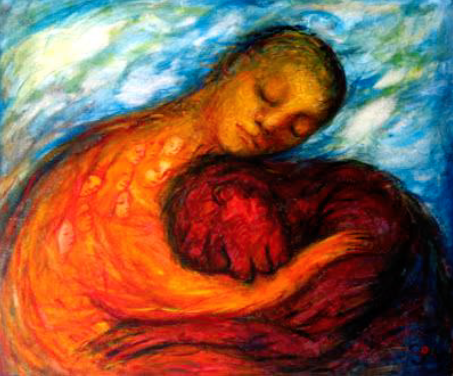
Forgiveness, by Sofiya Inger
How do we become better, more loving people?
Maybe a more churchy way of asking this question is this: how does conversion of life happen? What do we imagine is happening when we say the confession each week, for example?
I ask because in spite of the beautiful words of our liturgies and prayers, I think we in the church have often struggled to imagine what these prayerfully chosen words actually mean in our everyday lives.
We suffer from a lack of imagination.
So take just a moment and try to imagine what repentance looks like in your life… or forgiveness… or conversion.
What comes to mind?
Some of us might think of global conflicts that demand our best efforts at peace, or unjust systems we must fight to dismantle. Certainly, a willingness to persist in these ways is an important aspect of a hearty theological imagination. I think of people like Desmond Tutu, who could imagine a world without apartheid, and worked to make it a reality. Others might think of ruptures in particular relationships, or personal failings or blind spots that have led to conflicts, and the necessary work of reconciliation and amendment of life. Perhaps the most well-loved depiction of that kind of conversion is Ebenezer Scrooge in Charles Dickens’ Christmas Carol; and his imaginative journey through past, present and future.
But where is God at work in all of this? How do we imagine that God is involved in our conversion toward better, more loving people?
By the time the prophet Ezekiel was serving as a sentinel for the house of Israel, where God was in all of this was a central question for the exiled people to which he was sent. The first temple in Jerusalem had been destroyed. The people had acknowledged their collective waywardness, and attempted to turn back to the Lord, but they were still suffering the effects of exile, still longing for the legitimacy of a kingdom. All they could imagine was what they had lost. When would restoration come? What would it take to change course?
Despite the many historical and cultural differences between Ezekiel’s time and ours, I don’t think these questions are unfamiliar to us in our own cultural context. We, too, lament the waywardness and failure of our political leaders. We, too, consider what it will take to collectively change course on the climate crisis, for example. We regularly seek God in prayer, and in various ways we ask, “where are you in all of this? What will it take for change to happen? How do we become better, more loving people?”
Now the Bible includes a few different ideas about how humans can change. There’s the conditional, behavior-oriented language of the commandments in Exodus or Deuteronomy: If you do this, then you will live. If you don’t, then you will die. Then, there’s the somatic language of wisdom literature, like the Psalm from this morning: Incline my heart, turn my eyes, make my feet go in the path of righteousness. Texts like this seem to concede that following God’s commandments requires some divine assistance to get us to do what is required. In the text from Ezekiel today, humans amend their lives by following the advice of God’s chosen prophet. Ezekiel just has to tell the people the words he hears from God, and then the people can choose to turn from their wickedness based on his intervention.
But in other parts of Ezekiel and Jeremiah, people become better by God’s direct initiative- he will inscribe his law on their hearts¹, create in them a clean heart², give them a new spirit³, like a divine surgeon.
So there’s a variety of ideas, but in each of them, there is a creative tension that must be held. We human beings are simultaneously rough around the edges, and radically transformed by our relationship with God. Living into the tension between the two requires a robust theological imagination that can hold both truths at the same time.
Biblical scholars call this mysterious tension dual agency, or co-agency: a cooperative blend of human and divine action⁴ that enables us to act according to God’s desires. Christian theology calls it grace.
Both challenge our modern understanding of the self, and our western cultural value in acting self-sufficiently to accomplish whatever goals we set our minds to. Both involve engagement with God
“Self-help is America’s religion,” historian Kate Bowler says.⁵ There is a religious fervor to the self-optimization that pervades our culture. Ourselves, our communities…everything around us becomes a project that can be improved upon if we just lock in, and work a little harder. This is a kind of theological imagination, but it’s a thin one; a transactional, mechanistic understanding of ourselves and others that flattens our humanity into machine-like simplicity, and reduces our capacity to be present to those around us in love, just as they are.
In contrast, Jesus says to his disciples, “Where two or three are gathered in my name, I am there among them.” It is not conditional, or individual. It is communal.He inspires them to imagine themselves in communion, even when they are apart, because they are, and to work together even when they are opposed, because they are yoked together. He echoes the same idea from the Hebrew Bible that God acts in cooperation with human efforts to forgive, restore, and strengthen us. And so, with God’s help, maybe we can imagine becoming people who can tolerate the rough and unfinished edges of others, but can also tell them the truth about those edges. With God’s help, maybe we can imagine becoming people who delight in the sheer gift of grace, and simultaneously lean into the longing for a restoration that is beyond reach in this life. With God’s help, maybe we can imagine becoming loving people who can hold the tension between the two truths that we are both rough around the edges and radically transformed at the same time. It’s in this mysterious sacramental tension between human life and divine life that grace enters in and transforms us.
I am a native Tennessean, whose ancestors hail from Southern milltowns and Appalachian hollers, and after Dolly Parton died last week, I watched with appreciation and awe as the tributes to her memory poured in from every corner of our divided country. Her rags-to-riches trajectory could easily be mistaken for a classic American tale of individual self-actualization, and at least a few journalists have depicted it that way.
But Dolly Parton told a different story about herself- a story that inspired people, whether they were making it big or down on their luck, because it held the tension between the rough edges of her upbringing and her radical rise to fame. She claimed them both. Maybe one of the most captivating things about her was her ability to gently engage with nationally divisive topics, leaving imaginative room for people from opposing camps to enter into dialogue with her. When she sang about sexism in the music business, people who might never have given a feminist the time of day listened. When she wrote songs for Transamerica and Love Rocks, people who did not understand the queer community listened. When she rewrote her musical show, Dixie Stampede, to avoid glorification of the antebellum south, people paid attention.
One journalist said it like this: “In her life, as in so many of her songs, Parton celebrated understanding and forgiveness as a means of transcending rancour and shame.⁶”
I read that line and I thought, “what would it be like if the church was as well-known for celebrating understanding and forgiveness as Dolly Parton was? It’s in all of our songs and liturgies, after all.
What if we could hold the tension as well as she did between the rough edges of humanity and the radical transformation we believe is possible in Christ?
What if we could claim them both, welcome them both?
Can you imagine it?
_________________________________________________
¹ Jeremiah 31
² Psalm 51
³ Ezekiel 36
⁴ For more insight about self, agency and the spirit, check out Carol Newsom’s The Spirit Within Me and Reed Carlson’s Unfamiliar Selves.
⁵ Consider Bowler’s thought-provoking work as presented in this brief video: https://www.youtube.com/watch?v=c3tZR1ZY1N8
⁶ Read the full article here: https://www.bbc.com/culture/article/20201204-how-dolly-parton-became-the-worlds-best-loved-celebrity