
Preached on the Thirteenth Sunday after Pentecost (Proper 16A), August 23, 2026, at St. Paul’s Episcopal Church, Seattle, Washington by The Reverend Kelly Moody.
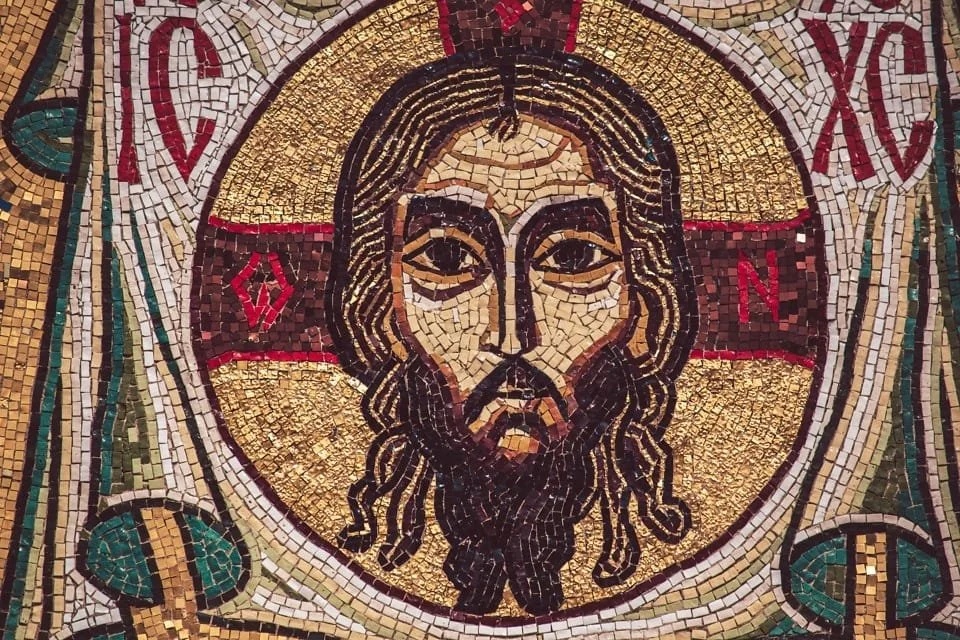
Byzantine style mosaic of Christ
Last summer, I had the opportunity to see “the David.” You know, the famous marble statue in Florence, carved by Michelangelo? He depicts David just before his battle with Goliath, tense, and turning to aim his slingshot. It’s a massive work of art, considered a renaissance masterpiece. Michelangelo’s famed precision and attention to detail was clearly apparent as I observed the statue from the gallery floor. But what I didn’t know was that the carrera marble block out of which Michelangelo carved the David was rejected by two other sculptors. The block was darkly veined, and riddled with small holes. And it was too narrow to accommodate the sort of figure that most sculptors envisioned. These imperfections forced Michelangelo to consider a different approach than he might have otherwise, and that unusual approach is part of what makes Michelangelo’s David such a masterpiece. No other sculptor was able to make anything of it. In fact, David’s back is missing a muscle because of a previous sculptor’s unsuccessful attempt to carve the stone. Michelangelo’s work has been celebrated for centuries, and it was possible, in part, because he was willing to embrace what others thought was ruined, and work with the imperfections in this difficult piece of stone.
“On this rock I will build my church,” Jesus says to Peter, who is not known to be the most solid of the disciples. Scholars have debated what Jesus is referring to when he says “this rock.” Is it Peter, or Peter’s faith in Jesus, or, perhaps the rock is Jesus himself?
The text is ambiguous.
In any case, Peter’s recognition that Jesus is the son of the Living God is apparently a foundation strong enough for Jesus to work with, in spite of any imperfections or ambiguities. Their relationship is secure.
That is not to say that Peter’s understanding of Jesus will not waver when faced with suffering and fear, because it will. It’s not to say that Peter will not be disappointed when Jesus does not do what Peter expects a messiah to do, because he will be. Peter struggles to recognize Jesus and what he is doing as often as he succeeds. But Jesus is willing to embrace it all, and work with the imperfections.
The word Jesus uses to describe what he is building on this rock is translated here as church, but it can also be translated as assembly, or congregation. So, another way of hearing this verse might be, “upon this relationship, where we recognize one another and work with the imperfections, I will gather my people, my congregation, into a secure relationship.”
We get a snapshot of Peter’s relationship with Jesus today in the gospel of Matthew, but what I find more compelling for those of us seeking to follow Jesus all these years later is Paul’s relationship with Jesus, and his recognition of Christ in the gathered body of the faithful in his letter to the Romans.
After all, Paul did not know Jesus before he was crucified. He came to know him after his death, in visions, and dreams, and the goodwill of other Christ followers. And in this letter to the Romans, Paul is writing to people who he likely never met, either… and identifying with Christ in them. Because all of them– Peter, Paul, these Romans– all of them are captivated by their belief that this Galilean teacher named Jesus was trustworthy, and was still present, and could be known. They were willing to risk persecution and rejection to meet him. And it’s gatherings of the early church, like this one in Rome, receiving Paul’s letter, that have passed down the words and practices of our faith that we still rely on today: Baptism. The pattern of our Eucharistic prayers. The laying on of hands. The collecting of scripture, like the phrase we heard today: we who are many are one body in Christ.
Upon this multi-generational relationship, Christ still gathers his congregation, and is made known to us, too.
Now throughout the course of history, many have given up on meeting Jesus in the church, because the church has failed to speak up at times… failed to bind worldly powers and loose the chains of injustice. Sometimes the church can appear to be an affinity group a or social club. Other times, it just fails to articulate the most important thing.
My friend was visiting a church for the first time, and upon attempting to dip her bread in the communion wine at the altar rail, the minister holding the chalice pulled it back and said rather sharply, “We don’t do that here.”
It was an impulse, with no intention of harm, but the outcome was startling. My friend’s eyes filled with tears. She returned to her seat, smarting from the interaction. At first, she felt shame and rejection. Then she felt anger. She hadn’t done anything wrong! How was she supposed to know what they did or didn’t do if it wasn’t explicitly stated? Then came rage. Surely this is not how Jesus would treat an outsider who was seeking him.
I hope you have not had an experience like this, not here or anywhere, but if you have, I am sorry. It’s worth lamenting when the church misses the mark and falls short of its calling. And it's important that we, the church, continue to repent when we fail.
Because Jesus still gathers his people and is made known among us. He still reveals himself in the words of scripture, read in a community of people earnestly seeking to follow him. Jesus still seeks out those who are looking for him, be they solid disciples or somewhat unreliable characters. He still reveals himself in bread and wine. Jesus still calls and empowers people in every generation to join him in loving the world, and loosening the chains that restrict our lives.
And this is the rock-solid foundation for our hope and persistence; that Jesus promised to gather and bless and empower all who come to him, and seek to know him. He was willing to take what others rejected, and work with the imperfections.
So if you find yourself distracted today by imperfections, doubts and failures, be they yours or someone else’s, take heart. There’s more to the story. The church is a place where we learn to recognize Christ in one another, and trust that the relationship is secure.