
Preached on Ascension Day (Year A), May 14, 2026, at St. Paul’s Episcopal Church, Seattle, Washington by The Reverend Stephen Crippen.
Acts 1:1-11
Ephesians 1:15-23
Luke 24:44-53
Psalm 47
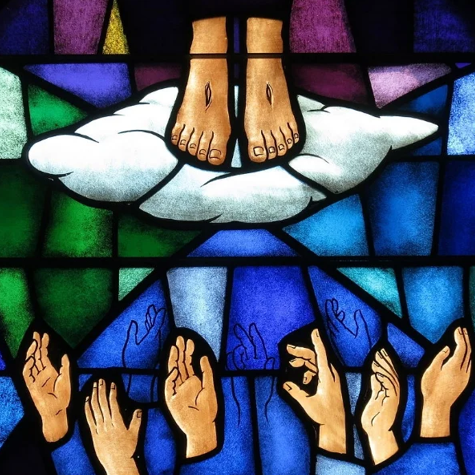
Stained glass detail Ascension from Saint James the Greater Catholic Church, Concord, NC
Jesus went away. Long ago. No one has seen Jesus of Nazareth, face to face, for about twenty centuries. He has been gone so long that there is a reasonable debate about whether he actually existed in the first place. (Let me hurry to say this: I hold strongly to the belief that he did exist in ancient Palestine, and if you like, I could discuss with you how the many accounts of his life, death, and resurrection have an uncanny way of describing the same person — an actual, living person — even as they remember him saying and doing quite different things.)
But anyway: he went away. This was an experience suffered by his very first followers, not just those of us who arrived on the scene about eighty generations later. The first record of his Ascension that we heard today — the one Luke records in his second volume, the Acts of the Apostles — gives us a hint that the first followers had some trouble accepting this loss. Two men in white robes appear (as they had done at Luke’s account of the empty tomb), and they ask the disciples, “Why do you stand looking up toward heaven?” The disciples should answer for themselves, but I can understand why I would stand there looking up. That’s where I last saw him. I would want to keep seeing him. I expect they wanted that too.
But they come down the mountain, finally, and return to the city, as he had instructed them to do. Back in Luke’s Gospel, volume one of his great work, we hear Jesus himself tell his followers to stay in the city, where they will be “clothed with power from on high.” Stay in the city: that is also our instruction. You want to see Jesus? You want to see the one who went away? You will find him right here, in the city.
But you will find him even closer than that. In a few moments you will find him in a morsel of bread, a chunk of starchy calories that you can clasp in your own hand. How is he found there? Well, the bread will be broken, as you well know, broken and shared. Before that, the bread was lovingly mixed and kneaded and baked by one of our companions. (The word “companion” means “with bread,” or “together by sharing bread”.) Jesus is found in that bit of bread you’re anxiously clutching because it is an outward and visible sign of the inward, spiritual grace we share as companions of Christ. Said more simply: the family that breaks bread together encounters the risen Christ together.
The bread quickens our bodies and focuses our minds, bending us toward one another, to our neighbor, and to the stranger, driving us all into a holy (and sometimes daunting) embrace. When I draw closer to you and you draw closer to me, and when together we come to this Table and eat the broken bread, we are bonded in love, we are united in mission; we are many becoming one, we were once lonely but now are held, hugged, healed. In all of this holy (and startling!) intimacy, we see the Risen One.
So — he went away, but he is in this bread.
And yet, he is elsewhere, too. Jesus Christ has ascended into the desperate and frightened bodies of refugees, into the bodies of human beings held and tortured in our government’s detention centers, into the bodies of our unhoused neighbors and all who are denied basic mental health care even as they are surrounded by immense wealth and prosperity. Jesus Christ has ascended into the Emergency Department of Harborview, at two o’clock in the morning, when the staff and patients are at the end of their ropes. Jesus Christ has ascended into the shelters and tunnels of Gaza, into the villages of South Sudan, along the fraught and explosive Strait of Hormuz, among the anxious citizens yearning for freedom on the island of Taiwan.
But he is elsewhere, too. Jesus Christ has ascended into your broken heart and your anxious mind. He has ascended into the quarrels and anxieties of a troubled married couple, alongside the sickbeds of our beloved friends, into the dreadful nightmare of anguished parents who lost their baby. He has ascended into the repentant heart of a person with white privilege encountering for the first time their lifelong complicity in white supremacy. He is ascending into the contemptuous heart of a transphobic activist who is determined to harm trans persons for no reason other than his reckless denial of their basic humanity.
Jesus Christ is ascending into the contentious conflicts in our court systems, into our federal executive branch as it commits war crimes, into our sclerotic and deadlocked Congress, into the judicial chambers of Supreme Court justices who are actively working to disenfranchise voters of color.
And what does he do in all of those places, so many of them so desolate and dreadful? Well — that good question defies easy and pat answers. It is obvious that the presence of Jesus Christ does not make it impossible for human beings to misbehave. His presence does not insulate us from injury, illness, discord, or heartbreak.
Jesus Christ doesn’t ascend into all times and places as a kind of magical talisman or amulet. He ascended alongside the deathbeds of both of my parents, and yet they both died. Looking outward, much more broadly, the risen and ascended Christ has not ended “forever” wars, or mitigated anthropogenic climate change, or deposed wealthy sovereigns from their thrones. Mary the mother of God sings that God has sent the rich empty away. Has God done this? If so, it doesn’t seem to have happened in an obvious way.
I have preached before about the great insight that Kate Sonderegger, my favorite theologian, offers about the nature of God. This insight can help us understand how Christ dwells in all times and places, and what Christ is doing here, and everywhere. Dr. Sonderegger reminds us that when God created the heavens and the earth, God did so in a jussive way. Jussive: this is a grammar term, a grammar mood. God said, “Let there be light” — this is a jussive way of commanding that light come into existence. In other words, it is more invitational than imperative. God did not say, “Light! You must appear now!”. God said, humbly if powerfully, “Let there be light.”
Jesus Christ, in turn, ascends into all times and places — ascends into our very bodies — not in order to take command of everything, but to invite goodness and justice to emerge, to grow, to finally overcome.
This means that if you and I are in a terrible argument, we are not under orders to behave ourselves. We could say and do awful things to one another. We could allow our conflict to damage the people around us. But Christ has ascended into us, and into our relationship, and so we are continually — if quietly, if humbly! — invited to choose the better part, to listen to the better angels of our nature.
Christ ascends into all times and places, but he does so in the same way he became incarnate. As the Word made flesh, Christ took on our weakness, our frailty, even our finitude: he submitted to death, even death on a cross. And now, even as the ascended Son who sits at the Father’s right hand, he still does not lord over us with aggression. He is never an autocrat.
This sometimes means that his presence, particularly at grievous places like deathbeds, is not as a wonderworker but as a caring, soothing companion. His caregiving finds its way to the dying person through our own patient hands, our own open hearts, our own sensitive minds.
And then there are other ways, moral and ethical ways, in which Christ ascends into us, and rises within us. But because his ascent is always jussive, always invitational, we can say No. We can always say No. If we do say No to the ascended Jesus, in our selves and in all our affairs, we could feel more in control, at least for a while. We could feel powerful. We might win a dirty fight. We might prevail in a mean-spirited argument. We might get everything we think we want.
And if we say Yes? Well, that could hurt. We would have to be honest; we would have to be the better person. Or we would have to draw closer to a scary or unpleasant neighbor. Or we would simply have to release control over the outcome of our efforts — that alone is uncomfortable and often unpleasant. Sometimes people say, with wry humor, “Jesus, take the wheel.” We could say just that. We could let the risen and ascended Jesus take over, make the next call in our affairs.
If we do, we are promised great gladness and wondrous transformation.
But always at great cost.