
Preached on the Fifth Sunday of Easter (Year A), May 3, 2026, at St. Paul’s Episcopal Church, Seattle, Washington by The Reverend Samuel Torvend.
Acts 7:55-60
Psalm 31:1-5
15-16; 1 Peter 2:2-10
John 14:1-14
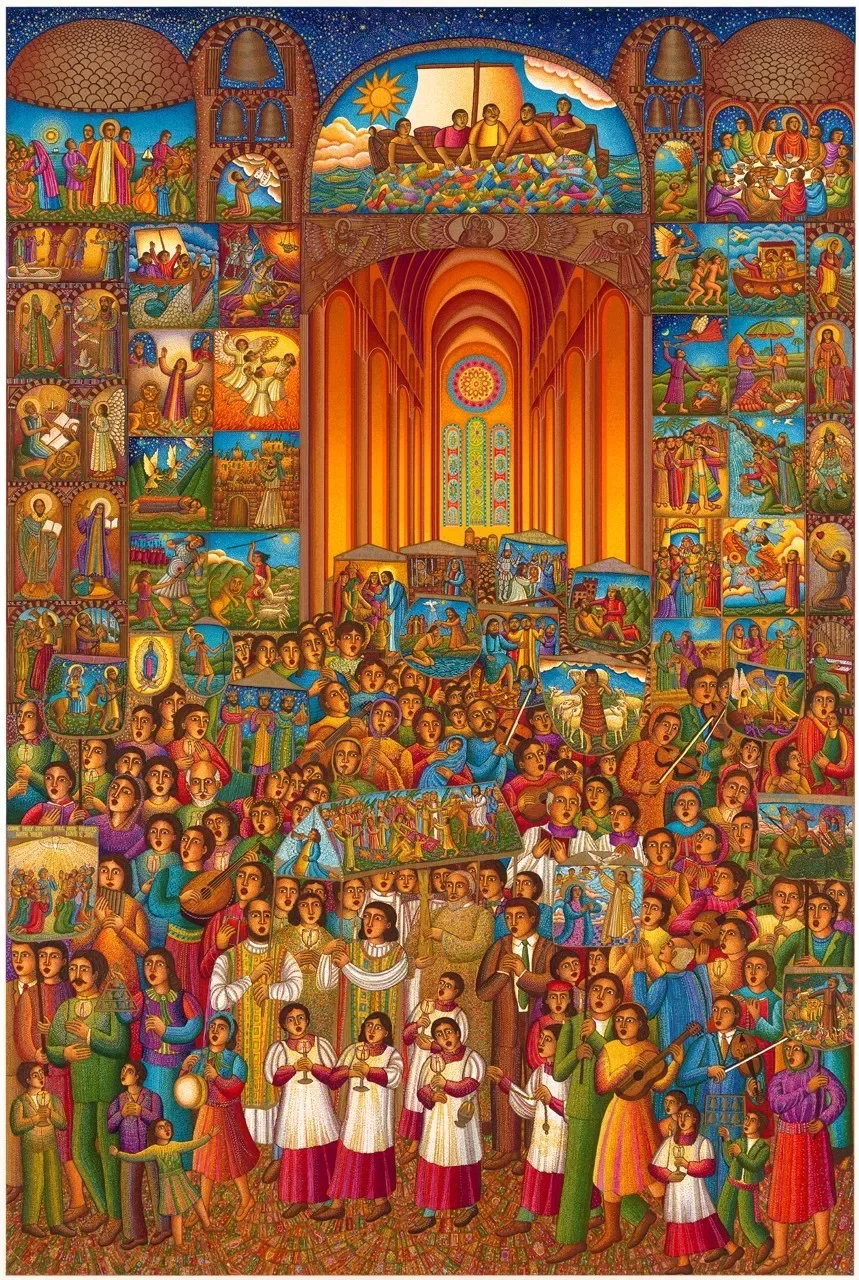
Procession, by John August Swanson
There was a time when it was possible to say, “He’s such a gay fellow,” and everyone knew that he was a joyful and fun-loving lad. But as we know today that word possesses a much different meaning, one that is affirmed by some and, sadly, derided by others. There was a time in the nineteenth century when people could say “he fizzled,” meaning he produced flatulence and did so quietly – you know, SBD: Silent But Deadly. But now that odd word means that something has failed, as in “the plan fizzled out.” Indeed, there was a time when the word “bully” actually meant “darling” or “sweetheart” – as noted in a number of Shakespeare’s plays – but now refers to an obnoxious person who intimidates in order to frighten, hurt, and punish others: the bully on the playground; the cyberbully; the bully in the Pentagon.
This redefinition of words, this transformation of meaning, was not lost on the writers of the New Testament; in fact, it was at the center of the writing. Why, we know that at the time of Jesus, many of his fellow Galileans believed that a militant messiah would arise and forcefully evict the much-hated Roman occupiers from the land the Galileans believed was given to them by God: a king like Solomon who engaged in territorial expansion; a leader who would subdue gentile nations, ushering in a period of peace – but peace won through violent conquest.
Yet a careful reading of the gospels indicates that Jesus rejected this image of a messiah. What did he say? “The kings of the gentiles lord it over [their people] ... But not so with you [not so with me] ... for I am among you as one who serves” (Luke 22:25-27) – as one who serves others. Indeed, we know that the service of his life among social outcasts, the poor, the lonely, the sick and dying, the overlooked, and the despairing was completed in his final act of self-giving love on the cross: the manner of his life led to his death. No: among Christians there should be no talk of a “militant” messiah regardless of what the “Secretary of War” says. For you see, we worship a crucified messiah, the one who identifies with human frailty and suffering, with our frailty and suffering. We worship the stone rejected by the builders: for what appears to be weakness in the eyes of the lords and warlords of this world is, for us, the very presence of God who is with you and me and this world: not only in our strength but also in our failures, our questioning, and our doubts. What did Stephen say as he was being stoned to death? “Bring your wrath upon my persecutors, O God, and annihilate their entire civilization?” No, I don’t think so. Rather, he said this: “Lord, do not hold this sin against them.” No word of retribution, of violence; only this: a word of astonishing and unexpected forgiveness.
We also know that at the time of Jesus, only males who came from the tribe of Levi were eligible to serve as priests in the Jerusalem Temple; individuals who were considered faithful followers of the Law; a priestly caste, as it were, who served as mediators between the people and their God. No women. No males from other tribes. No individuals of questionable sexuality, of questionable ethics, for one’s social status mattered greatly. And yet, to the utter surprise of many, the author of the first letter to Peter, transforms this ancient word, priest, by writing that in the waters of baptism women and men, children and the elderly, moral failures and virtuous folk, the lowliest in society and the overlooked by the lords of this world have become what? A royal priesthood. No wonder the ancient marking of the newly-baptized was done with these words: “You are anointed as a priest in the Body of Christ.” Yes, you and me made priests as scented olive oil was traced on our foreheads in the sign of the cross; made priests, says First Peter, to offer spiritual sacrifices.
But, then, if there is no ancient temple in which we worship, what does it mean that you and I, as priests, are called to offer spiritual sacrifices? After all, we do not lead a human victim to an altar for slaughter; no animals are slain in our midst and offered to God; there is no bloody sacrifice. On the other hand, one might assume that what we do here – our worship – is such a sacrifice, such an offering. But, again, I think not. Rather, the author of First Peter echoes a sentiment found in the writings of St Paul and the gospels: we come to this place to give thanks to God for this good earth, for our lives, and for God’s sustenance of life, and then we ask God to offer life and sustenance to others through us. What, then, might the call to offer spiritual sacrifice mean? Why nothing less than offering our lives as nourishment to those who are hungry for food, for companionship, for strength to carry on. As priests of God, your spiritual sacrifice and mine is enacted outside the doors of this house; it is offered in the home, the workplace, the public square – in all those ordinary places where we discern human need and – yes – human suffering.
Our Eastern Orthodox friends speak of two liturgies that are linked together: the liturgy we celebrate in this house in which the crucified and risen Christ serves us with his Body and Blood, with the wounds of his love, and then the liturgy you and I enact as God’s priests who serve the spouse, the child, the parent, the friend, the co-worker, the stranger, the victims of the warlords of this world. The Orthodox priest and theologian, Alexander Schmemann, said this of the spiritual sacrifices we offer in daily life: “We hear these word at the end of the liturgy: ‘Let us depart in peace.’ This does not mean, of course, that having worshipped in church, we simply go home and ‘relax,’ having completed our religious duty. We are given this command,” he writes, “and it is precisely as a command that these words must be understood – for the Eucharist leads us into the mission of Christ in the world.”
The only question is: will it be welcomed by each of us?