
Preached on the (transferred) Feast of Saint Mary the Virgin, Mother of our Lord Jesus Christ, August 16, 2026, at St. Paul’s Episcopal Church, Seattle, Washington.
Isaiah 61:10-11
Psalm 34:1-9
Galatians 4:4-7
Luke 1:46-55
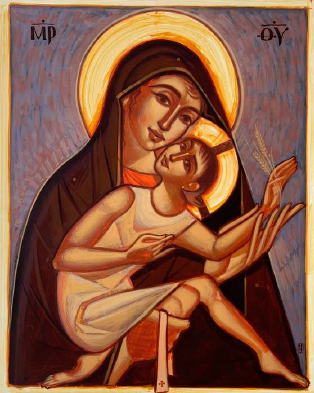
Icon by George Makary
Surely, from now on all generations will call me blessed; for the Mighty One has done great things for me, and holy is his name.
Our parents bless us. That is to say, our parents hand things down to us. Some of their gifts are conscious: they deliberately try to raise us a certain way, to instill certain values. They teach us how to treat our friends. They teach us what’s important, and what’s not. They teach us who is kin and who is an outsider. Sometimes they teach us how to vote, how to think, how to behave at dinner, even how to feel.
Other things parents give us are unintentional, unconscious… and they’re not all blessings. Sometimes parents let their children down in ways that give them deep-seated anxiety, and make it hard for their children to form strong emotional bonds with people. My parents formed secure emotional attachments with me, but I think they unintentionally taught me to suppress emotions, midwestern-style. I had to learn from somebody else that big feelings are useful, and good; that if I learn to work with them, they help me make better choices about my life.
Today we celebrate — we call “blessed,” we bless — a human being who is many things, as all of us are, but whose identity as a parent perhaps looms largest in our imagination. Saint Mary the Virgin has many titles, but perhaps her chief title, her primary claim to fame, is Mary the mother of Jesus, or Mary the mother of our Lord, or (we Christians came up with this title a bit later on) Mary the Mother of God.
Mary’s identity as a parent concerns us deeply. And as the mother of Jesus, she blesses him with many things. She also hands down to him, as all parents do (even absent or problematic parents) her worldview, her history, her legacy.
She has the most to do and to say in the Good News according to Luke, where she gets to sing the mighty Magnificat, a triumphant song of praise that echoes her Hebrew forebear Hannah. (Hannah is yet another mother who blesses her child Samuel with powerful and provocative blessings!)
But back to Mary, and Mary in Luke’s Gospel: Mary’s Magnificat is an aria, not a recitative: She takes all the time she needs to sing God’s praises for bringing about the triumph of justice and peace through her, by her inconvenient and potentially scandalous pregnancy, with her own physical body.
We’ve never met Mary as Jesus did: obviously, whatever relationship we may have with Mary the Mother of God, the Queen of Saints, none of us knew her in first-century Nazareth. It is difficult to find the historical Mary behind ages of Marian devotion.
Mary captured the medieval imagination across several centuries, so much so that an ordinary Christian could mistake her for the Holy Spirit, given how powerfully she reigns as a source of consolation, comfort, and inspiration; as the majestic Lady Wisdom; as the divine feminine who pervades the created world with fecundity and beauty.
Mary is often, for us, a Madonna sparkling in a robe of stars, the Queen of Saints, iconic and beautiful, rising above our mundane world in sublime serenity. Think Queen Elizabeth the First, the virgin queen who said she was “married to England” and ruled her people wearing splendid gowns of fine silk, velvet, silver, and pearl. Her noble face was inscrutable, majestic, fierce, and her elaborate white makeup covered all human blemishes.
But Mary of Nazareth, the mother of Jesus, most likely looked nothing like that, and had a much more earthy character. She was a brown woman, probably quite short of stature, a survivor in a patriarchal world that routinely ignored or mistreated her. Physically she probably looked more like AOC than Elizabeth the First.
Now, I share the love many of you feel for Mary the Queen of Saints. Marian devotion is part of who we are in this Anglo-Catholic parish. When we revere Saint Mary; when we find her standing triumphantly on the moon; when we contemplate the astonishing mystery of the incarnation in which Mary’s womb contained “heaven and earth in little space” — all of this Marian piety powerfully deepens our understanding of God and humanity, both. We can begin to grasp how we, too, are ordinary human beings who nonetheless shine with God’s glory.
But it is also helpful to reflect on the historical Mary of Nazareth, a human being, born of a human being, who gave birth to a human being. Her son was divine and human. Mary of Nazareth has gifts for us. She inspires good questions for us to consider: What did Mary give to her son? How did she bless him? How did his life, ministry, death, and resurrection reflect her influence?
I have some ideas about all of that.
Mary gave her son the trauma she suffered in her very body as a peasant-class young woman in an occupied land. Just in the last decade or two, we have learned that trauma is not just an emotional (let alone a merely intellectual) experience, or memory. Trauma is experienced by, and remembered by, our bodies. The author Resmaa Menakem, in his book, My Grandmother’s Hands, studies the trauma of slavery and white-body supremacy suffered by black and brown bodies, and transmitted by those bodies to their children, and their children’s children.
But Menakem goes back even further in time, prior to the arrival of African people on this continent in 1619, and traces the trauma suffered by white bodies, inflicted by other white bodies, in medieval Europe and then in colonial America. Only generational trauma, held and transmitted in physical bodies, can explain both the invention of whiteness itself — for race is nothing but a social construct — and the ability of white people to oversee the atrocious genocide of red bodies, the destruction of black and brown bodies.
Only body trauma can explain how white people considered lynchings a form of entertainment. Only body trauma can lead white people to stop seeing people of color as human beings, and endorse and perpetuate wretched acts of violence against their bodies.
Menakem leads his readers toward authentic hope that we can — all of us, in different ways — overcome this legacy of trauma. But we can’t do it until we face it, and work with it, and teach our bodies to heal from it.
So: back to Mary of Nazareth, peasant girl, survivor of oppression, inconveniently pregnant in a time when such a pregnancy could mean her early death. (We also arguably live in a time like that.) Mary was the mother of Jesus. She blessed him with her trauma history, among other things, among other blessings.
Given what we know from the Gospels, those other things were lovely: she blessed him with courage, with gumption, with faithfulness. She was not a serene porcelain statue, but rather she bore in her body the kind of strength Michelangelo appreciated when he created the Pietà. Mary held her son’s body with her body, after his death: Mary was mighty. And so, in turn, was he.
But again, she had a hard time of it, given her social location. And so I think we can assert that she blessed him with the identity of an oppressed person, as well as the passion to stand up for other oppressed persons, and give his life away for them. She blessed him with resilience, with a spirit of endurance, perhaps also the spirit of serious engagement with and alongside humans in peril.
In John’s Good News Mary organizes the rescue of a couple and family from the debilitating social shame of running out of wine at their wedding party. That may seem like a trivial problem for us, but in that honor-shame culture, the family was about to be in extremely big trouble. Perhaps they would be ruined by such a serious social faux-pas.
And at that wedding she turns to — who else? — her son, born of her body, and conscripts him into service, blessing him with a sense of urgency and solidarity with his neighbors in need.
And so we praise Saint Mary today, not only because she is the Star of the Sea, but also because Mary the earthy mother blesses us with many of the powerful and provocative blessings she handed down to her son.
I believe Mary’s blessings are named in a prayer written by the Right Reverend Gene Robinson, a bishop who suffered plenty of trauma in his physical body. He led a blessing prayer just before the inauguration of a president whose black body was about to carry into public service an immense amount of courage, insight, and compassion, all of it grounded in generations of trauma suffered by his ancestors, on this land.
Here is Bishop Robinson’s prayer.
O God of our many understandings, we pray that you will…
Bless us with tears – for a world in which over a billion people exist on less than a dollar a day, where young women from many lands are beaten and raped for wanting an education, and thousands die daily from malnutrition, malaria, and AIDS.
Bless us with anger – at discrimination, at home and abroad, against refugees and immigrants, women, people of color, gay, lesbian, bisexual and transgender people.
Bless us with discomfort – at the easy, simplistic “answers” we’ve preferred to hear from our politicians, instead of the truth, about ourselves and the world, which we need to face if we are going to rise to the challenges of the future.
Bless us with patience – and the knowledge that none of what ails us will be “fixed” anytime soon…
Bless us with humility – open to understanding that our own needs must always be balanced with those of the world.
Bless us with freedom from mere tolerance – replacing it with a genuine respect and warm embrace of our differences, and an understanding that in our diversity, we are stronger.
Bless us with compassion and generosity – remembering that every religion’s God judges us by the way we care for the most vulnerable in the human community, whether across town or across the world.