
Preached on the Fifth Sunday in Lent (Year A), March 22, 2026, at St. Paul’s Episcopal Church, Seattle, Washington by The Reverend Samuel Torvend.
Ezekiel 37:1-14
Psalm 130
Romans 8:6-11
John 11:1-45
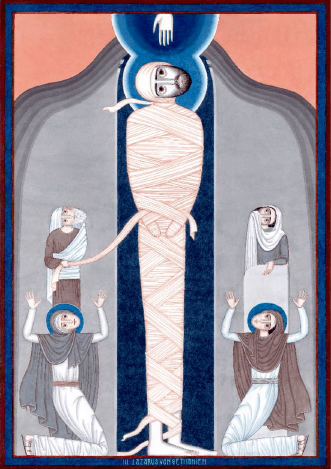
St. Lazarus of Bethany, by Nikola Saric
I think the creation of a healthy relationship relies, in good part, on the ability to keep one's promises: The promise to show up on time; the promise to do what one has promised to do; the promise to be faithful “for richer, for poorer,” in sickness and in health; the promise to be faithful in marriage to one's spouse; the promise to serve the wellbeing of one’s employees and coworkers rather than oneself. For we know – do we not? – the disappointment as well as the anger that accompanies the broken or failed promise.
Some 70 years after the death and resurrection of Jesus, the editor of the fourth gospel we call John, addressed his gospel to a dispirited community in mourning. And the cause of their grief was this: they believed that Jesus’s promise of eternal life would take place in their lives, would take place in their lives so that they would not experience death. “You promised us eternal life and yet we continue to bury our dead community members.” And so, in the gospel reading for today, Mary serves as the voice of this late first century community when she says to Jesus: "Lord, if you had been here my brother would not have died" – that is, none of us would die if you had been faithful to your promise; none of us would be lost to death if you had ushered in eternal life while you were still with us.
It is this misperception, this misunderstanding, that John corrects in his gospel, a correction directed at his community when Jesus says, “I am the resurrection and the life.” But the promise of resurrection did not and does not abolish death. The promise of resurrection did not entail the resuscitation of a corpse. After all, Lazarus would eventually die. What John wants his community to know is this: faith in the risen Christ is not fully developed, does not mature, until it enables his followers to embrace physical death in confidence – in confidence because they are already united to the risen Christ.
But there is more: the promise of resurrection does not begin at death, at some point in the future, but now, right now in the present. To trust this promise is to see it alive in one’s experience, in our life together, as we participate in the life of the ever-living Christ in the present moment. That is, those who have been washed into the life of the risen Christ, who have been baptized into his death and resurrection and nourished with his Body and Blood, are already experiencing eternal life. This is to say that the future has entered into the present, into your present and mine.
But you might ask, What does living the resurrection and the life in the present look like for us, we who live 2,000 years after John completed his gospel for a community anxious about death? Why there is a clue in the today’s gospel: “The dead man came out,” writes the evangelist, “his hands and feet bound with strips of cloth, and his face wrapped in a cloth. Jesus said to them, ‘Unbind him, and let him go.’” Note that Jesus does not unbind the restrictive burial cloths enclosing his beloved friend. Rather he asks the community gathered around Lazarus to do this: he asks them to engage in the work of releasing this bound brother so that he might live freely in the present moment. That is, he asks you and me to recognize that Lazarus is among us today ... and that our first work is to come to this table and be nourished in his ever-living life, to come to his supper and receive his resurrection energy – so that – so that you and I might engage in the good but challenging work of advocating for those who are vulnerable among us: the immigrant and the transgender person, the lonely and the forgotten, the houseless, the hungry, and those caught in poverty, the fearful and the discouraged.
Oscar Romero, the martyred bishop of El Salvador, in his reflection on this reading from John, preached this: “To each one of us, Christ is saying: If you want your life to be fruitful, [to be filled with the power of the resurrection,] do as I do. Give your life away out of love to others and for others. Give yourself away yet do not be afraid. Those who shun the suffering of this world remain alone. Indeed, no one is more isolated than the selfish. But if you give your life out of love to others, you will grow and flourish, reaping a great harvest.”
And so I wonder: will this sage advice, will this paradox, lead you and me into the days ahead? For you must know, dear friends, that the world in which we live today desperately needs nothing less than the power of the resurrection and the life as witnessed in your loving action.