
Preached on Palm Sunday (Year A), March 29, 2026, at St. Paul’s Episcopal Church, Seattle, Washington by The Reverend Stephen Crippen.
Isaiah 50:4-9a
Psalm 31:9-16
Philippians 2:5-11
Matthew 27:11-54
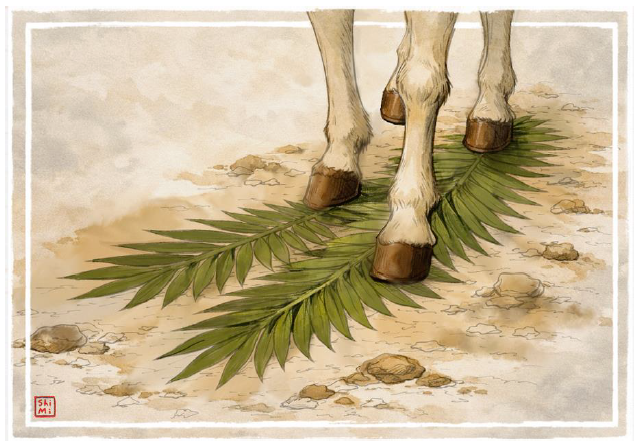
“The greatest among you will be your servant.” Matthew 23:11, Artwork by Claire Fox (Shimi)
A short reading from The Doctrine of God, by Katherine Sonderegger:
“Love is the Truth of God, but also the Beauty. God is sublime, a zealous Good. Love alone is as strong as death, its passion fierce as the grave. To know this God, the Living Lord, is to hunger and to delight and to hunger once more. Theology should pant after its God, the Love that is better than wine, for God is beautiful, truly lovely, the One whose Eyes are like doves.”
Love is the Beauty of God.
Love is beautiful.
You’ve been to weddings. You’ve appreciated how carefully couples plan everything, the invitations, flowers, party favors, placecards, dresses, suits. The goal is beauty: on this day the couple and their community celebrate love, and love is beautiful.
In 1970 my grandmother, a skilled and patient seamstress, created a beautiful baptismal gown for me, covered in an intricate leaf-and-branch pattern. The little gown is a wondrous work of creativity, and love. Several of my nieces and nephews wore my gown at their baptisms. Love is beautiful.
Here are more occasions of beautiful love:
Not long ago someone asked me what I like most about my work. I told her about an experience I share with many of you, lay and clergy alike. I told her about drawing alongside parishioners at St. Paul’s, being present with you in your struggles, in your adventures, in your losses. Three times in the last year, I have been evangelized by the honesty and insight of companions who were about to die. Countless other times, I have seen beautiful, tremendous courage in the eyes, in the flinty faces, of companions who grapple with illness and adversity.
There is magnificent human beauty in these struggles, but even more astonishing beauty in our intimacy. Terrible intimacy! Piercing grief. But behold its beauty.
But ultimately, in our discernment about the beauty of love — in our contemplation of the idea that love is the Beauty of God — Christianity takes on a particularly challenging task. We look up at a dreadful, disgusting, atrocious, revolting sight — a man fastened violently to a wooden frame, dying in agony — and we strive to see great beauty there.
His love for his friends, his love for his enemies, his love for us, his love that inspired him to give away even his life rather than abandon us — that beautiful love transforms those bloodstained planks of wood into a Tree of Life. Maybe you know the ancient chant about this glorious Tree of Life: “Faithful cross, above all other, one and only noble Tree; none in foliage, none in blossom, none in fruit thy peer may be; sweetest wood and sweetest iron, sweetest weight was hung on thee.”
How beautiful is our Lord and Savior, beautiful in his condescension down to us, down into our muck, down into our plight. How beautiful is his free release of power, his closing of a safe distance from us. How beautiful is his emptying of self so that he could abide with us, sharing in our living and our dying, our glories and our grief, our passions, our sorrows, our endings.
Weddings, baptisms, the ordinary companionship we share here — these poignant encounters reveal the beauty of love, the beauty of God. But again, look at that Tree of Life, that Tree of Love. Look there, and see the most exquisite beauty, the most terrible gift, the most sublime love. For this is love that comes at immense cost. This is love that reveals the cost of all loves, even the loves that seem easier by comparison — the love of newlyweds, or the love that washes over you at your baptism. Even those joyous forms of love foreshadow great struggle: a marriage takes a lot of work; baptism in Christ is a drowning, not just a happy washing. Our lesser selves drown; the easy and safe spiritual paths are flooded. Love hurts; love comes at a price.
The beauty of love, then, is terrible. Just ask a sponsor helping someone get clean and sober. Ask a counselor confronting a client with the truth they need to hear. Ask the parent of a struggling young adult. Ask our neighborhood missioners drawing alongside the unhoused. Ask our Eucharistic visitors bringing Communion to someone who is dying. Ask our altar servers watching as the ashes of their friend are poured into the earth. Ask a widower trying to live without his lifelong sweetheart. Ask yourself how terrible, and yet how indescribably beautiful, your love is for your people, your chosen family, your closest heart friend.
The writer Naomi Klein commented recently on the mighty solidarity that women journalists offered to survivors of sexual assault who stood up to confront their abusers. Listen to how Naomi describes these courageous women:
Naomi Klein says, “And the women journalists who believed them when nobody else did, this is a beautiful story. I mean, it’s a horrible story, but there’s also beauty in it.”
Klein reflected more on the beauty of solidarity. She said, “Everyone is so cynical about those early Covid days when people clapped for health care workers. But I actually think there was something really beautiful about what was being expressed, [something really beautiful about] insisting on seeing the people who make the world work, who hold the world up.”
But Klein acknowledges that simply standing alongside someone — alongside an abuse survivor, or a health worker, or anyone else on our long list of human survivors in these hard times — Klein acknowledges that, as she put it, “clapping [our hands in approval] is not enough. [The Covid health workers] also deserved wage increases and sick days and all kinds of things that they didn’t get.”
Klein said that our society had a choice in those worst days of the pandemic. We had the option to really side with people on the front lines, to really lift them up, and not just applaud their heroism, as beautiful as that encouragement was. Klein says, “This is what I mean by that fork in the road that Covid represented: There could have been a breakthrough for labor rights. [But] all of the discussion about who essential workers were… was very threatening to a lot of people, and that’s why we’re in this fascist alternate timeline.” We chose the easy road.
But all is not lost. We can still choose better. We are still at that fork in the road. Naomi Klein, in her conversation with another writer who shares her surname — Ezra Klein — then reflected on people in our present day who stand alongside the oppressed and make real gains on their behalf.
We are always at this fork in the road, you and I. One direction leads away from justice and health, away from equity and peace; the other direction — the painful one, the horrible but beautiful one, the excruciating path — that way lies all we long for, all we pray for, all we want for every living human person, and for the earth herself.
And: at this fork in the road where we are standing today, contemplating the terrible beauty of human courage and love, and contemplating which path we finally might take — at this fork in the road rises this beautiful, terrible cross, shining with love as strong as death, with passion fierce as the grave.