
Preached on the Ninth Sunday after Pentecost (Proper 12A), July 26, 2026, at St. Paul’s Episcopal Church, Seattle, Washington by The Reverend Kelly Moody.
1 Kings 3:5-12
Psalm 119:129-136
Romans 8:26-39
Matthew 13:31-33,44-52
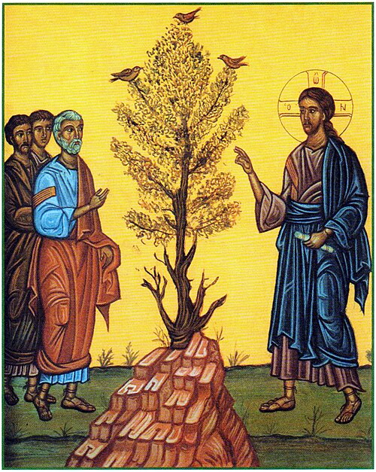
Jesus and the parable of the mustard seed, artist unknown
The kingdom of heaven is like yeast.
In the first year of the pandemic, I had a dear friend here in Seattle who took up sourdough bread-making. I imagine you knew someone, or maybe you were someone who took up pandemic baking, too. Journalists suggested that we were drawn to baking bread not only out of necessity, but because it required mindfulness and physical touch, both of which relieved stress in an anxious time. As businesses closed and grocery shelves were emptied,baking bread grounded us in something ordinary and productive that met a need during a season of uncertainty.
My friend’s sourdough hobby became so grounding for her that she baked nearly every day.
Cinnamon rolls, delicious breads of every kind, you name it.
Each day she dropped them on the porches of friends and family, who gratefully received them as the weeks went on. And all of this was possible because of a gooey yeast, a sourdough starter in a jar, shared with her by a neighbor who had gotten it from a friend, whose sister had given it to her. This sourdough starter with a complex ancestral line sat bubbling on my friend’s counter more often than not. It was honestly kind of unsightly. In its gooey, bubbly form, it did not convey what it was capable of becoming.
Today, Jesus compares the kingdom of heaven to yeast. Not to the transformed and completed loaf of bread or fine wine that the yeast can produce in time under good conditions, but the yeast itself. The gooey, messy fungus that a woman ‘mixes’ or ‘hides’ into three measures of flour.
The connotation in the Greek is that no one knows it’s there, except the woman.¹ She plants it in the flour like a seed. Yeast is a living organism, but it’s not a plant, and it’s not really an animal, either.² Strains of yeast can travel through air, or grow in a jar like a sourdough starter, or ferment in a barrel of beer or wine. They permeate and expand and decompose, transforming whatever host they’ve found in ways that scientists are still discovering.
The kingdom of heaven is like yeast.
Mycologists, the scientists who study fungi like yeast, admit that they do not yet fully understand all that these organisms are capable of. One evening during the pandemic, while enjoying our sourdough bread in the form of grilled cheese sandwiches, our family watched a documentary called “Fantastic Fungi.” We learned that there are three hundred miles of fungi growing under every footstep we take anywhere in the world. We marveled at their vast thread-like connections underground, and their role in the endings and beginnings of nearly every living thing. Scientists have discovered that fungi can filter water and heal certain ailments, among other things.
So if the kingdom of heaven is like a yeast, well, that is a metaphor worth exploring…a mysterious network of connections and processes still surprising scientists today.
That’s what struck me as I considered this parable about yeast- the mystery is still unfolding.
Joseph Campbell famously said “if you want to change the world, change the metaphor,³” and Jesus offers more than one metaphor in today’s rapid-fire series of parables.
But I think it would be all too easy to hear the parables Jesus tells this morning from the confines of our success-oriented, bigger-is-better culture,and only hear the message that greatness can come from small, humble beginnings. That’s true, of course, but I think there’s something more nuanced and hopeful to unpack here, something deeper.
After all, we do not really need a parable to tell us that God’s kingdom is mighty.
We need parables to hold the mysteries of our faith…We need parables to draw us into stories that disrupt our easy assumptions and surprise us…. We need parables to remind us that the kingdom of heaven is growing in and around us all the time, like a common weed, or a jar of sourdough starter on a friend’s kitchen counter.
We need parables to work on us, like a yeast works in flour, until there is enough room in our hearts and minds to believe that God’s heavenly reign really is mixed up and hidden in the messy, ordinary details of our common lives…and hidden in the unsightly places in our communities, too.
Because that can be more difficult to believe, and frankly, more inconvenient.
Jesus chooses images to describe the kingdom of heaven that point us toward an unfolding mystery rather than a linear progression of constant improvement. Jesus invites us to see his kingdom working its way into everything, seeding our lives and our city with the presence of God…working toward a holy completion that can look like decomposing gooey yuckiness before it ever resembles a lofty loaf of bread. But when you know it’s there; when you know what it is, you don’t have to avoid it anymore.
The kingdom of heaven is like yeast.
Over the next few months, you and I will get to know each other as we pray and serve together in this beloved place, and I’m really looking forward to that. I hope you’ll share stories about the places you’ve seen God’s kingdom unfolding here. I hope you’ll share about the practices of faith that anchor you in uncertain times. I hope you’ll share stories that are not yet finished, too, stories that may not yet reveal what we are capable of becoming. Because it’s in these messy, unfinished places that I believe Jesus is inviting us to meet him today to catch a glimpse of the unfolding kingdom of heaven. It’s in these vulnerable, uncertain moments that we are leavened with God’s love and sent out to share the good news that God’s reign prevails.
________________________
¹ See A.J. Levine’s Short Stories by Jesus on the significance of translating the verb as “hides” rather than “mixes.”
² A quote from Fantastic Fungi
³ Quote shared here on StreetPsalms