
Preached on the Eighth Sunday after Pentecost (Proper 11 A), July 19, 2026, at St. Paul’s Episcopal Church, Seattle, Washington by Laurel Tallent.
Isaiah 44:6-8
Psalm 86:11-17
Romans 8:12-25
Matthew 13:24-30,36-43
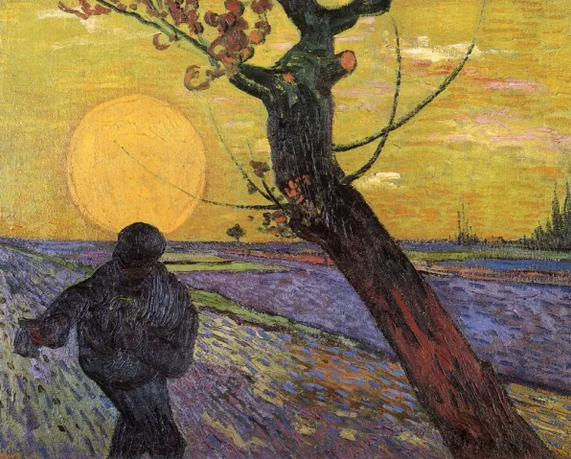
Sower with Setting Sun, by Vincent van Gogh
I am three generations removed from depending on my own crops. I have never planted a wheat field, I have not gone out to examine it, searching for evidence of ruin, and praying not to find it. Still, my very existence depends on the unseen labor of agricultural workers. Whatever distance we put between ourselves and the field, our shared dependence on agriculture gives us, and the first listeners of this parable, and millions of people in between, a common vocabulary for our most vital concerns. This parable is concerned with the persistent problem of evil, its presence in the world, and its destruction.
As with many parables, we approach it by asking “who is what?” Jesus identifies the field as the Kingdom of Heaven, and Matthew’s interpretation of the parable, following Jesus’ telling of it, casts other roles: The Chosen One, who we understand as Christ, is the farmer sowing good seed, the field is the world, the good seed are citizens of the kingdom, the weeds secretly sown in the field are the children of the evil one, and the enemy is the devil.
Let’s begin with ourselves: In this parable, we are the good seed, the wheat. I want to ground us in that identity because it is the first glimmer of the Good News in this passage, and it communicates the dimensions of the parable. We are wheat! And what does wheat do? Grow! That’s about it. The action in this parable is out of human control, outside of the sphere of our influence.
The good news is this: God has planted this field of good grain, and God is tending the field. Not only is God aware of Evil, it is God’s work to eliminate it. The day of reckoning is coming, and it is not your job.
I don’t think that I shirk responsibility, but I am relieved by this news. I can see that this is an untenable situation. The farmer’s work, if not wasted, has ballooned. The weeds growing among the wheat are horrifying, not only because they threaten the growth of the harvest but because of their indistinguishability. There’s a creepiness to that.
The Psalms and gospels provide us with a number of allegories where we are the sowers of seed. I like these images. They give me a sense of agency and purpose, and strengthen my convictions when the work of discipleship is hard.
Their application is simpler: in the allegories where we are the sower, we are sowing seeds of the Kingdom when we love each other and God, when we feed and clothe each other, when we prevent or destroy the means of exploitation and abuse. When we do things within human grasp. This invasion of evil is not in our grasp. So it is good to hear: God will tend this field, burning the evil that inhabits the good world God has created.
This spring, I had the opportunity to attend a lecture on Karl Barth and the Problem of Evil at Virginia Theological Seminary, given by Dr. Sonderegger (a theologian who’s spoken at this pulpit, and received a lot of love from our rector). Barth, the subject of her lecture, was a Swiss Reformed theologian and contemporary of Bonhoeffer. One of Barth’s ideas about Creation is to reject a duality of Good and Evil, and consider a third way: there is God our creator who surrounds us and is with us always. There is all of God’s creation, present company included, named as “good” from the beginning of creation, but still fallible and mortal. Then, there is the nothingness of Evil.
In her lecture, Dr. Sonderegger emphasized Barth’s definition of evil: Evil is NOTHING, it is not created by God. Evil does not have the dignity of being created by God.
The weeds in our parable were sown by an enemy, they are not a part of creation. There are weeds in God’s field. Despite their nothingness, they are taking up space. If we consider the King James translation of this passage, these weeds are called “darnel, " a kind of ryegrass that hosts a toxic fungus that in turn infects wheat as well; an un-making of a harvest.
Evil, in its indignity, does not know Imago Dei. Evil does not know what it means to be made in God’s image, so it moves without care. I’m sure you have felt the edges of Evil in your life. It grows next to you and me and each of us. There is nothing you and I can do to stop it.
Here again, is the Gospel Message: God will work the field and destroy the weeds. Beyond that, as we know and contemplate every Easter season, God has already tended to the field and burned the weeds. Evil has already been defeated. It was not created, but it has been unmade. The day of reckoning has already come. You and I, little stalks of wheat, might not feel that, but this parable assures us that is and will and has happened.
Both the reckoning and the weeds are beyond our perception. As wheat, we are never outside the field where Evil is planted, so it is impossible to have objective knowledge of it. But since many of us have been taught this parable as a way to sort good and evil people, I think we need to consider the identity of the weeds.
We were each created, sown, by the farmer of this field. When we indulge in the idea that some people are just evil, we are denying the work of God’s creation. We are surrounded by evil, we are choked and hindered by evil. We might be poisoned by evil. But you will be wrong every time you turn to a neighbor and name them “weed”.
We can see that Evil has infected the world around us. We witness human decisions that discard human life. We can see Evil so clearly that sometimes we struggle to recognize the humanity of tyrants through the dense growth of their evil choices. But we have failed to recognize evil, and we have misidentified it. Consider all of the times when the Church and her people have failed to discern correctly. We failed to recognize evil in slavery and racial bigotry, in empire and colonialism and a hundred other sources of marginalization and terror. We misidentify it in things that are new to us: Consider how we have challenged the goodness and legitimacy of every new letter added to the LGBTQIA acronym. We routinely fail to see the harm that can come from our own good intentions, and we misunderstand other people’s motivations. I wonder what else we have misidentified, what we have not seen, or are incapable of seeing. So we continue to confess: We repent of the evil that enslaves us, the evil we have done and the evil done on our behalf. We are not capable of understanding the evil that surrounds us. We are not capable of tending the field that God has sown.
When we respond to our perception of evil, and rely only on our own understanding to destroy it, we will inherently create something too small, and too fallible. We will lose the path to something even more beautiful. If we respond to discord by striving for perfect agreement, we are rejecting Jesus’ invitation to build solidarity with each other. If we respond to violence with retribution, we are rejecting grace.
Even in allegories where we are the sower in the field, God is the one who brings the Kingdom that frees us. Even if you yearn for more or bigger work in this very broken world, I hope you see the liberation in that division of labor. We already have abundant work.
In Madeline Miller’s novel exploring a female perspective on Greek myth, the titular character, Circe, chooses to become mortal after a truly harrowing life of immortal existence. Her son has died, and she has very few comforts except a loom that Daedalus built for her. In the closing chapter of the novel, Miller’s Circe considers a broken thread in her weaving, and reflects that she will content herself with “the quiet mending of the world”. She chooses a mortal-sized task as a mortal being.
God will tend the field, now and forever. Thanks be to God.