
Preached on The Twenty-Fourth Sunday after Pentecost (Year A), November 8, 2026, at St. Paul’s Episcopal Church, Seattle, Washington by The Reverend Kelly Moody.
Amos 5:18-24
Psalm 70
1 Thessalonians 4:13-18
Matthew 25:1-13
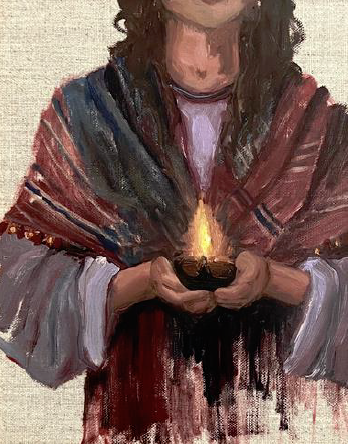
Oil in Her Lamp, by Jenny Komenda
I have a smartwatch that tracks my sleep, among other things. It tells me how long I rested, what the quality of my sleep was, and other interesting patterns of data. But these days I find that I’m more attached to the metric than I would like to be. If the sleep score is bad, I’m disappointed, even though it’s perfectly normal to have a rough night here and there. If the metric is good, I feel that I’ve accomplished something, even though all I did was sleep. Information like this can be useful of course, but there’s so much more to pay attention to about the quality and impact of sleep than the numbers on my watch.
And that’s what I want to explore with you this morning: the dissonance that can come with knowledge. We can know so many things now with relative ease. We can search the entire internet in seconds, ask google anything we can’t remember. No need to trek to the library during business hours anymore to find the most updated encyclopedia when you’re curious about something. Can’t remember what time the post office opens? Google it. Wondering who the coach of the Baltimore Ravens is now? You know what to do. No worries about missing that event– it was recorded, and you can watch it anytime. Your lab reports came back? Who needs a doctor, drop those numbers into ChatGPT and see what they mean!¹
The point is, all of this knowledge is so easily accessible, but I am not sure it has made our lives better. I don’t think it has expanded our perspectives or made us more compassionate to people who are not like us. On the contrary, I think access to so much information can lead us into a false sense of certainty. Because for all the superficial knowledge we can access, there are many things we cannot know, at least not like this. How will our health change in the next twelve months? Who are our neighbors, and how can we love them? Where are our habits and consumption out of line with our values, and what motivates us to change them?
Knowledge alone, and the speed with which we can access it, is not enough to live a just and holy life. We need discernment. We need humility and companionship. We need the wisdom of God.
In Jesus’s parable, all ten bridesmaids have knowledge about an upcoming wedding. But none of them know when the wedding will be. Five bridesmaids get ready to wait for an uncertain amount of time; they brought extra oil. Five had the certainty of the wedding alone. Maybe they googled “how to prepare to meet the bridegroom,” and there was no mention of bringing extra oil. I don’t know, but they weren’t prepared to wait.
Notice that all ten of them fell asleep. But the five who had found a way to sit in the uncertainty were able to enter into a new reality with the bridegroom when he finally arrived, while the other five remained in the old reality, unable to enter in.
Now I want to pause here and say that I know it can be tempting to get hung up on the bridegroom’s seemingly callous behavior in this story, or to advocate in righteous anger for those poor bridesmaids who were shut out of the celebration. But I wonder, if this parable is not about having access to all the insider information, what could it be about?
What if it is about cultivating a way of being with the unknown? Keeping the light burning in the darkness of uncertainty²? What if the oil is how we stay connected to God when justice is delayed, and disappointment comes, or questions loom large?
The Gospel of Matthew was likely written down after the fall of the Temple in Jerusalem, for a community whose world had turned upside down. So many sure and certain powers were coming to an end, and in their wake there was instability, but there was also freedom to imagine a new world order. How would they live in the midst of that kind of upheaval? What had Jesus taught them that could help them make sense of the times, and live into the possibilities for justice and righteousness? You’ll hear some of Jesus’s takes over the course of the next few Sundays, as we explore the apocalyptic texts of these last chapters in Matthew. They can be hard to parse, but the world into which they spoke was marked by at least as much chaos and confusion as ours is.
Later in Christian tradition, saints like Benedict of Nursia distilled Jesus’s words about how to live with apocalyptic uncertainty into wisdom for everyday life. Benedict was born about 70 years after the fall of Rome. So he, too, was well-acquainted with late-stage empire dynamics, and the uncertainty they can create. Benedict’s deep conviction was that God’s presence was everywhere, so everything one did could be offered as a prayer; a collaboration with God. He designed a rule of life that taught people to listen for God and be open to hearing God’s guidance moment by moment. And in responding to God’s guidance over time, Benedict believed we would be transformed into more loving, Christ-like people.
Benedict’s way of living, was oriented around three core principles: prayer, obedience, and conversion of life. Maybe a better way of saying it for our postmodern minds would be prayerfulness, or listening with the ear of our hearts; responsiveness to God’s Spirit, and a willingness to turn toward the doors God opens in our lives³. Living like this requires us to pay attention differently to the world around us. Instead of scouring it for information and data we can use, we are to be still and listen, attending even to the silences and absences around us⁴. We are to invite God’s attention to help us make sense of things.
This threefold rule for attentive living is like extra oil for a lamp that burns in a dark night. It anchors us to the presence of God in the midst of uncertainty and superficiality. Being aware of God and God’s desires as we go about our lives in this uncertain world is not knowledge we can google or track on a smartwatch. There are no metrics…no obvious rewards. It’s simply a daily practice of paying attention, and inviting Jesus to pay attention in and through us.
For Benedict, the frequency of our turning toward God was far more important than getting the words or rituals just right. Each time we turn to God and ask for guidance, Benedict believed that wisdom would grow within us. Maybe you could say the oil in our lamp is replenished. And as we practice paying attention with God in ordinary moments, we develop the ability to recognize Christ among us in the most unexpected places. This is how we are made ready to participate in the new reality of justice and righteousness he is ushering in right here, in the middle of the chaos and confusion of our world.
So the next time you begin to google something, or check a number on your smartwatch, I encourage you to pause first, and remember the presence of Christ. Invite his attention into the moment. Maybe this simple practice will enable us to sit with the Unknown just a little longer, and discover new ways to keep the light burning for all people in the midst of apocalyptic uncertainty.
I’d like to close with a prayer:
Almighty God, by whose grace St. Benedict, kindled with the fire of your love, became a burning and a shining light in the church: inflame us with the same spirit of discipline and love, that we may walk before you as children of light; through Jesus Christ our Lord. Amen⁵.
_________________________________________________
¹ I do not actually recommend this!
² https://streetpsalms.org/proper-27-32-year-a/
³ See chapter 72 of the Benedictine rule of life. There are a few Benedictine monastic communities in the United States, including St. John’s Abbey in Minnesota, The Community of St. Mary in Sewanee, The Order of the Holy Cross in New York, and St. Gregory’s Abbey in Michigan. Check out their websites for resources and retreats.
⁴ To read more about respect for silence in Benedictine religious communities, see Chapter 42 of the rule. Many thanks to Sister Egeria Mark at the Community of St. Mary, Southern Province in Sewanee, TN for helping me articulate Benedict’s ideas in this sermon!
⁵ This is an older version of the prayer, taken from Esther de Waal’s excellent book, Seeking God: The Way of St. Benedict. The updated prayer for Benedict’s feast in Lesser Feasts and Fasts, 2024 is as follows: “Gracious God, whose service is perfect freedom and in whose commandments there is nothing harsh nor burdensome: Grant that we, with your servant Benedict, may listen with attentive minds, pray with fervent hearts, and serve you with willing hands, so that we might live at peace with one another and in obedience to your Word, Jesus Christ our Lord, who with you and the Holy Spirit lives and reigns, one God, now and for ever. Amen.”