
Preached on The Commemoration of All Faithful Departed (Year A), November 3, 2026, at St. Paul’s Episcopal Church, Seattle, Washington by The Reverend Kelly Moody.
Wisdom 3:1–9
Psalm 130
1 Thessalonians 4:13–18
John 5:24-27
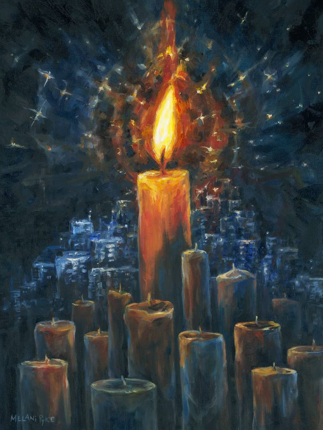
Light of The Candle, by Melani Pyke
One day in the future, some of you may very well look back on these days, in early November of 2026, and say, “you know, those were the good old days.” Perhaps you will say it as you recall the souls around you now with gratitude, and long to be with them once more. Or when a child in your life crosses a graduation stage, and tears swell in your eyes because you can hear the sound of their voice when they were 3-years-old, you might find yourself saying it then.Or perhaps tonight you might find yourself recalling an earlier period in your life, when someone you loved was still alive.
Perhaps you still recall the texture of their coat, or the smell of their cologne, or the safety you felt in their presence. Scientists who study memory call this nostalgia. It is a sweet human experience, warm, sometimes aching with longing.
It is a good and holy thing to return these moments. Nostalgia is often stirred here at church, through familiar smells and sounds, returning us to a memory in the past that’s blessedly free from the friction of nitty gritty details.
But nostalgic memory is not all we are left with when time passes, and our beloveds die.
We Christians are not merely nostalgic for Jesus and his last Supper, or for those who are no longer with us. Rather, we proclaim a present connection through the resurrected Christ; an eternal moment, reaching forward and backward in time simultaneously.
Christians are communities of Jesus-followers gathered across time and space, life and death, and into a communion that transcends any single gathering in history alone. When we celebrate the Eucharist, we are stepping through our temporal experience into the eternal reality of Christ’s resurrected life with all the faithful departed, and all that are yet to come.
Paul describes in his letter to the Thessalonians how the braiding together of temporal experiences and eternal realities should comfort us when our friends and loved ones die. He says, “We do not want you to be uninformed, brothers and sisters, about those who have died, so that you may not grieve as others do who have no hope. For since we believe that Jesus died and rose again, through Jesus, God will bring with him those who have died.” They will be among us, and we among them, in the Body of Christ.
The kind of memory that Christians engage in when we remember Jesus’s death is not nostalgia, but Anamnesis. Anamnesis is a fancy word for describing how we, as people who follow Jesus now, are joined to those who have followed Jesus throughout the ages
through the Paschal mystery we proclaim each time we pray at this altar. So we are not merely calling to mind what happened a long time ago, or what his death meant in its historical context. We are entering into it now, experiencing it in the context of our lives. Sacramental worship is the Church’s effective proclamation of God’s mighty acts and promises eternally- acts and promises, completed in the past, but whose impacts are still unfolding among us.
These eternal moments shape our capacity for relationship, even with those who have died. We weren’t there physically thousands of years ago when Jesus taught the disciples, and yet we know his voice. We didn’t sit at the table with him then, and yet we receive his hospitality here. We didn’t see his healing miracles ourselves, and yet we are healed as he becomes known to us in bread and wine. Events in the past come forward into the present and come to bear on our lives today, even in the nitty gritty details. And these encounters give us hope, not merely nostalgia for a moment in time that has slipped away.
I spent a lot of my early life with my grandmother when I was growing up. My mom worked evening and night shifts at the hospital, so my grandmother would pick me up from school, take me to my after-school activities, make me dinner, teach me to say my prayers, and put me to bed. My grandmother was just a delightful person to be around. She was spunky and joyful, anxious about small things, yet completely fearless when danger struck. She was the most faithful person I knew, and her love for me was fierce.
After a long, slow decline with Alzheimer’s disease, my grandmother entered hospice in the spring of 2011. I flew home to Nashville with two small children in tow and sat at her bedside for days on end, recalling the goodness of our ordinary life together.
She didn’t always remember me.
Her agitation came in waves, and when it did, she would try to get out of bed and get away from the misery she was in.
My nostalgia couldn’t reach her then.
The only thing that settled her, for a moment anyway, was prayer. Recalling the presence of Christ in songs and prayers soothed her. Those days were difficult to bear witness to. The nitty-gritty details of death often are. But they were underscored by something truer than the pain; something greater than the number of times I had to remind her who I was: The death and resurrection of Jesus: already complete, yet still unfolding in their impact. The presence of Christ, made known to my grandmother over and over again,until she could finally let go.
There is a difference between nostalgia for the past, sweet though it may be, and the hope we proclaim in Christ. That hope is an anchor for the whole of our lives. Every nitty-gritty detail of it, all the way until the end.
So do not grieve as others do who have no hope. Jesus is with all those who have died, and by his resurrection, Jesus is with all of us who are still alive.We remain in communion through him…and together, we long for the full revelation of death’s defeat.