
Preached on Christmas Eve, December 24, 2025, at St. Paul’s Episcopal Church, Seattle, Washington by The Reverend Stephen Crippen.
Isaiah 9:2-7
Psalm 96
Titus 2:11-14
Luke 2:1-20
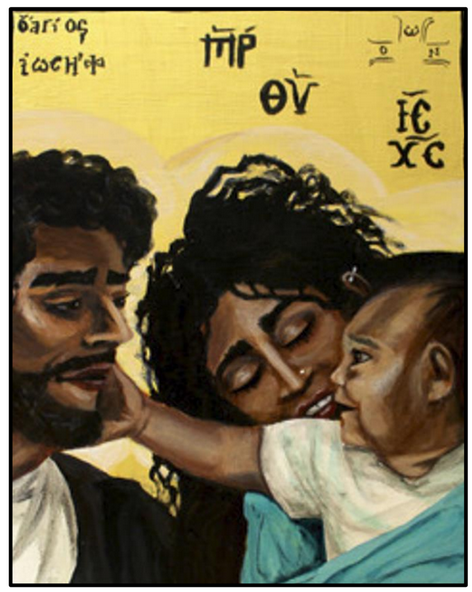
Holy Family, by Gracie Morbitzer
O holy child of Bethlehem, descend to us we pray.
Cast out our sin and enter in; be born in us today.
“Be born in us today.”
Yes. I want that. I want Christ to be born in us today, right here. I can think of a few places in particular – certain places in our here and now – where I would very much like Christ to be born, where I believe Christ is truly born.
Here’s a good one: Christ is born in hospital waiting rooms. Just this week I spent an anxious half hour in a hospital waiting room while a nurse worked on the medical needs of one of our parishioners. And I can tell you: Christ is born in that waiting room at Harborview, born into the worry and the fretting of every exhausted soul that lingers there. Christ is born in that waiting room to reassure the friends and families of patients that whatever happens, they will not be alone, and they will be saved from despair. I returned to the side of our friend with renewed strength.
But Christ is also born around our friend’s treatment room, and all the rooms along that floor, along every floor of that hospital. Christ is born into the hands and minds and hearts of the nurses and physicians making their rounds. Christ is born into the bodies of friends and family sitting in uncomfortable chairs around uncomfortable hospital beds, breathing and praying and quietly talking under those awful fluorescent lights. Christ is present throughout that vital, human building, not to magically relieve anyone of suffering, but – again – to liberate everyone from loneliness and despair.
But Christ is born in other places. Christ is born in ICE detention centers. Christ is born in detox clinics. Christ is born in supermax prisons. Christ is born in hospice deathbed rooms. Christ is born in couples-therapy offices, in playhouses and concert halls and theaters, in school counseling offices, in shuttered USAID centers, along war fronts, in hurricane relief centers, in dangerous mineral mines, in art museums and libraries, in delivery vans and ride-share cars, in cabinet rooms and state houses and governors’ mansions. Christ is born wherever humans are struggling; wherever humans are in peril; wherever humans are making art; wherever humans are giving birth; wherever humans are sick, ailing, or dying; wherever humans are alone. Christ is born wherever humans are helping other humans – but also when we are helping other creatures. So Christ is born at the veterinarian clinic, too, and Christ is born in the struggle to rescue animals trapped in factory farming.
A distant island slowly sinking beneath the rising sea – Christ is born there, born to lead the people into a hopeful future.
A bombed-out hospital in an occupied territory – Christ is born there, born to raise up new life from the ashes.
Your personal moment of crisis in your private life, a crisis you believe no one you know will understand – Christ is born there too, born to guide you, born to heal you, born to lift you up.
This is why it rings so true that our neighbors experiencing homelessness repeatedly tell us that simply looking in their eyes and saying hello is more valuable than food or even warm clothing. Of course we reliably share with our neighbors the food and clothing we all depend on for survival, but it’s the eye contact, the human-to-human “Hello”, that is truly life-saving, truly life-restoring. Christ is born in that “Hello,” born to guide us all into healing and life-giving friendship.
Here’s another way to say it: God is with us in these holy connections. Emmanuel is with us whenever we embrace each other, or even simply greet each other. I sat by myself in that waiting area at Harborview, and I sensed I was slipping under the waves of loneliness: my close friend was going through a life-threatening crisis, I felt helpless, and I didn’t know anyone in that waiting area. And yet I felt the reassurance of Christ’s promise to be with all of us, to abide with all of us, to knit us all together as one Body. I was strengthened to endure that lonesome hospital moment by the starchy sustenance I receive week by week here at this Table. I knew that everyone in that hospital – which in this moment included me – everyone in that hospital was being prayed for. And I had my own pastor close by, reassuring me via text message. God was with me there; Christ was born there; I was not alone.
Tonight, you are not alone. We build a faith community here week by week, a group of people who are here first and foremost to embrace you. If you’re new, we will embrace you and then teach you to embrace the next newcomer. Or maybe you have something to teach us. Some of the folks who arrived here in the last two or three years have knocked me over with their faith, their insight, their myriad spiritual gifts. Christ is born in all of our encounters in this house of God, this gate of Heaven.
But there is one key place in particular where Christ is born. Christ is born most especially in the very bodies of the people who are in the most dreadful peril, the people in the line of fire, the people being wheeled into surgery, the people shackled and caged by our government, the people conscripted for war, the people working in a sweatshop, the people who are sure they won’t live through the night, the people who feel sure no one cares if they live through the night.
We Christians proclaim this Good News by saying that the Christ child was born in the back room of a first-century Palestinian house, born to an anxious couple who initially weren’t sure where they would lodge for the night. We care about that young family. We remember and sing about their story, year after year.
But when we sing that Christ was born in a manger, that image can sometimes fall a little flat: how many of us have actually seen a “manger”? Manger scenes look good on greeting cards, but how do they really matter? We need to take another look at the story. Let’s go deeper than the gentle Christmas image of a baby wrapped in bands of cloth and lying in a bed of hay. This isn’t merely an image of a sweet, serene baby being rocked to sleep: this is an image of extreme, backbreaking poverty. This isn’t just a quiet and humble young family: this is a terrified refugee family, frantically depending on distant relatives for makeshift lodging. This is a woman giving birth without anesthetic or sanitary equipment. And the shepherds are dirt-poor laborers working the night shift. Christ is born into a desperate crisis.
So as much as Christ is most certainly born into the strong hands, open heart, and sharp mind of the nurse who tends his patients through the night, Christ is born especially in the broken or ailing bodies of those patients themselves, born into their weakness and vulnerability, born into their fears, born into their solitary struggle for companionship, born in them with power, born in them with abiding, heavenly peace.
But let’s keep going deeper. An infant in a feedbox can be a pretty way of saying that Christ is born in the bodies of prisoners on death row, visited by people who affirm their innocence, or, if that is not possible, people who affirm that no one is as bad as the worst thing they have done. Christ is born in the bodies of Black and brown human beings incarcerated by masked agents, joined in solidarity by allies and advocates. Christ is born in families torn apart by violence, guided to safety by counselors and social workers and pastors. Christ is born into all of our desperate crises – all of them, so that even as we live in a terrible and dangerous world, we live in a beautiful and hopeful world, too.
This past year, two of our members ended their time as companions of an unhoused neighbor. They became his friends, offering assistance and guidance, but more importantly offering ordinary human conversation. They got to know him, and they allowed him to get to know them. Finally, his health failed and he knew he was near death, so he reached out to his friends, to our friends. And they offered him prayerful companionship in his holy death. Finally, they helped arrange a funeral liturgy for him in our chapel, where this parish commended his soul to God.
You could say that these good people were good Christian companions, and you’d be right. You could even say they are Christ-like, for indeed they are. They study the scriptures, they say their prayers, they know the assignment. But Christ was born to them not just in their good works, but even more powerfully in the life and witness of their companion, their neighbor and friend. His body was the manger for the Christ child; his body was the cradle for the Incarnate One.
The holy child of Bethlehem descends to us, even now. The holy child of Bethlehem is born in us today – on the street, in the detention center, in the hospital bed; in the body of the unhoused neighbor, in the body of the deported migrant, in the body of the suffering patient. All heaven and earth fits into these ordinary human beings. God’s presence and power is crammed in their sacred bodies, and whether they live or die, they will never be separated from God.
Meanwhile, deep inside the most desperate and lonely human heart, a heart torn in two by anxious worry and even terror about being alone — deep inside that vulnerable human heart, the angel choir, even now, today, this very night, is singing Gloria.