
Preached on the Twenty-First Sunday after Pentecost (Proper 24A), October 18, 2026, at St. Paul’s Episcopal Church, Seattle, Washington by The Reverend Kelly Moody.
Isaiah 45:1-7
Psalm 96:1-9, (10-13)
1 Thessalonians 1:1-10
Matthew 22:15-22
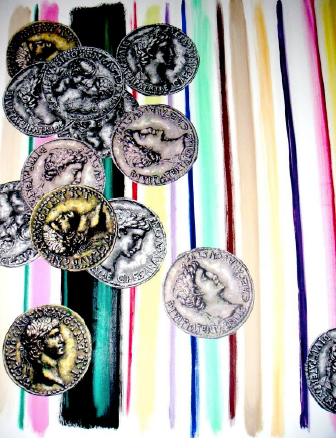
stars and stripes opus 1, by Carl Martham
In 2016, NPR reported that packets of ramen noodles had usurped cigarettes as the currency of choice inside many U.S. prisons¹. Supposedly, inmates pay one another for services, like cleaning a bunk or doing another person’s laundry, using uniform and durable packets of ramen². Ramen noodles are valuable in prison because they can be eaten in one’s cell, freeing an inmate from the tyranny of terrible prison food, and offering greater freedom over when and what they eat. A locker full of soups tells you that an inmate is managing pretty well on the inside. But a locker full of ramen in any other context… well, that wouldn’t tell you much at all, would it?
Recognizing what counts as currency in any group is important information. Ramen as currency in prison systems is an example of an alternative economy that rises up whenever the conditions or values of a particular group of people collectively shift from the status quo. In United States prisons, the adoption of ramen as currency across prison cliques, racial groups, and security levels was a functional way of expressing power and freedom in a world where both are scarce.
So, what would you say is the currency of this Christian life we participate in together? Do we have an alternative economy? And if so, how are we to pay back to God what is God’s, as Jesus suggests in the text today?
We find ourselves this morning once again in Matthew’s world, a violent world populated with religious hypocrites, Roman oppressors, insiders and outsiders, and one Torah-abiding Jesus who came not to abolish the law, but to fulfill it. And Jesus’s brilliant response to the Pharisees' trap invites yet another question that Jesus doesn’t: what do we owe God?
Like us, the Pharisees had been listening to these difficult parables Jesus was telling about vineyards and laborers and wedding garments–all material signs of doing well in the dominant economy. They could probably tell that Jesus was using these items alternatively in his parables. And theoretically, the Pharisees should have been on board with his message. After all, they were the ones living among the people in villages, and adapting Torah to the culture around them. They were the ones softening the legalism of the written law with oral tradition, and practical wisdom for ordinary people seeking to live faithfully.
And yet, Jesus’s parables offended these culturally-competent Pharisees enough to provoke them to malice.
I think that should perplex us.
After all, we, too, wrestle with the implications of being caught up in an unjust power structure. We, too, are implicated in the violence and harm done by the economic and political systems in which we participate. We, too, are looking for tangible ways to live into God’s kingdom and resist the powers and principalities that pull us in a different direction.
What do we owe God in a world like this?
Bishop Marianne Budde says there are three possible answers to this question: 1) nothing, 2) some portion, or 3) everything³. For those of us who hunger for the presence of God and God’s kingdom of justice and mercy, nothing cannot possibly be a satisfying answer. Some portion is more likely, and perhaps it was the answer the Pharisees would have chosen. Some portion could look like giving each Sunday morning to the worship of God, and some percentage of our income to our church. Maybe it would include one hour a week of volunteering, or study, or prayer. It’s clearly an intentional effort, and a reasonable one.
But it isn’t as though God only cares about some portion of our lives. It isn’t as though God is not present among us in the other six days of our week as we work and play and care for ourselves and others. It isn’t as though God has not given us wisdom about how to spend the rest of our money and our time when we are away from church. The portion that we set aside for does not “pay off” some tax to God.
Living as though it does produces hypocrisy, and all of us who are trying to live in relationship to God with any sort of intention are in danger of it.
So, answering the question of what we owe God with some portion doesn’t work, either.
The only viable answer is everything. Everything matters to God.
One of our Eucharistic prayers says it like this: “Fountain of life and source of all goodness, you made all things and fill them with your blessing, you created them to rejoice in the splendor of your radiance.⁴”
Everything in this world is sacred, created by God, and filled with blessing. So from the moment we wake and shuffle out of bed each day, we are to live as though that is true. In order to give God everything, we are to live and move and have our being for the glory of God. We are to nourish and care for our bodies, expend our energy and talents at work and home, and relate to one another in companionship with God. In God’s economy, our currency is love. Love of God, loving our neighbor, love for one another, loving our enemies. Love expressed through tangible acts of care for the earth, for the communities in which we live, and for people we don’t even know. We invite Christ to dwell in us, so that all we have and all we are might reflect Christ’s love in this world. So, what we give and receive, how we relinquish privilege and reorder our common life–these are all material decisions we make with God’s help.
I think many religious people are generally on board with this idea. But when it comes to making material choices each day in this world’s economy to prioritize mercy and love instead of power and control, or to live as though everyone and everything is sacred and filled with God’s blessing, well, that is where the hypocrisy can creep in.
The good news is that hypocrisy is not the end of the story; not in Matthew’s world, and not in ours, either. As Christians, we trust that Jesus will strengthen us to do his will each time we ask, and each time we gather together and receive him in bread and wine, so that we can participate in God’s economy without malice or hypocrisy. What we give to God is transformed in this Eucharistic meal, and given back to us as Christ himself, who is mercy and renewal and love for the whole world.
We owe God everything. But God’s economy is not like the transactional economies of this world. What God wants is not the same as what Caesar wants, and the currency is entirely different, too. In God’s alternative economy, we give freely from what we’ve been given, and we become what we receive: The gifts of God, for the people of God.
So, may you experience the joy and freedom that comes with giving your all in God’s economy. May you receive the strength and courage to make a material change in your life that reflects the mercy, justice, and love to which we are called. And may you experience Christ’s companionship wherever you are, inviting you ever deeper into the life of God that pulses among us everywhere.
_________________________________________________
¹ https://www.npr.org/sections/thesalt/2016/08/26/491236253/ramen-noodles-are-now-the-prison-currency-of-choice
² The original study was conducted by a University of Arizona student and described here: https://news.arizona.edu/news/noodles-supplant-cigarettes-prison-currency-choice
³ Read her sermon on this text in her book, Gathering Up the Fragments
⁴ Eucharistic Prayer D, found on p.373 of the Book of Common Prayer