
Preached on the Sixth Sunday after Pentecost (Proper 9A), July 5, 2026, at St. Paul’s Episcopal Church, Seattle, Washington by The Reverend Stephen Crippen.
Zechariah 9:9-12
Psalm 145:8-15
Romans 7:15-25a
Matthew 11:16-19, 25-30
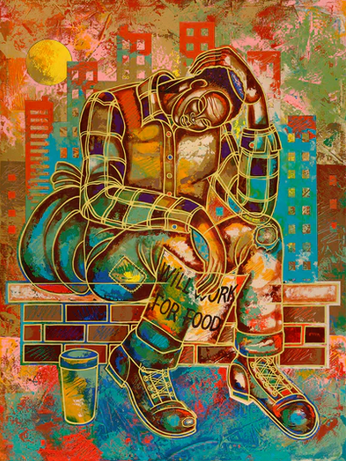
Heavy Burdens, by Larry Poncho Brown
I recall several experiences across my life, especially in the early years, when I had most of my needs met, but I really just needed a little more help. That’s all — I needed more help. Can you relate?
When I was a small child, I needed significantly more attention than my overwhelmed parents could give me. When I was a confused and scared junior in college, I had one strong helper when I came out as gay, but I needed much more guidance than that one person could possibly give.
Across the decades of early adulthood and early midlife, I needed help with career discernment, several times. Without that help, every step was slower, every transition more difficult. I finally found my true vocation, but not until a couple of months before my fiftieth birthday.
Now, please be assured that I am well aware that I am just fine. Much more than fine. By any reasonable human or historical standard, I luxuriate in embarrassing opulence with physical health, housing, and income in my fifties that would have been unimaginable for my prairie-farmer ancestors. When I was in seminary, my favorite priest and theologian lived in a small house just off campus, and she remarked that her little two-bedroom rambler was a vast palace.
This humble faith leader knows her bible. She is acquainted with the problems of poverty and injustice, and she is gratefully aware that by any reasonable metric of human experience, she is living in grand style, as are most of us gathered here.
But – wealthy or not, privileged or not, each of us and all of us need help. The writer Anne Lamott wrote a book called Help, Thanks, Wow: The Three Essential Prayers. Those three words really do encompass all of our prayers. Whether we pray to God in a shout or a whisper, we reliably say variations on the themes of “Help!”, or “Thanks!”, or “Wow!”.
In a few moments we will do what we always do, Sunday by Sunday: having opened the Word of God, and having reflected on what we encountered there, our reflections will drive us to our feet to pray for help: help for all people in need, help for ourselves, help for those who are sick, help for those who have died and those who mourn, help for the nations of the world – and, especially today, help for our troubled nation, celebrating its semiquincentennial in a time of widespread traumatic injustice.
Later on this morning, as usual, we will then happily sing our “Thanks” and “Wow” prayers around this Table.
So: you need help. We all do. I expect you are here, consciously or not, because you need help in some form. Maybe you feel like one of the prophet Zechariah’s poor ones, one of the people of God who feel imprisoned in a “waterless pit.” That’s a fairly dramatic, maybe melodramatic, image for those of us who are caught up on our mortgages and certain that we will have dinner tonight. But there are all sorts of “waterless pits” that we may occupy.
Maybe you’re parched by grief, or thirsty for friendship, or dehydrated by regret and remorse. All of us together might be in a waterless pit, and in fact the prophet Zechariah would assume so: he addresses his words of reassurance to a whole people, not to an individual. What waterless pit might be rising around all of us right now? Whatever it might be, Zechariah says it is a kind of prison.
We may not feel imprisoned by warfare and violence, but if we call ourselves allies of citizens of Ukraine, or Gaza, or South Sudan, to name just three places of massive insecurity and atrocity, then their suffering is somehow ours, too, and we cannot, or at the very least we should not, rest until their lives and futures are secured. We — they — need massive amounts of help to accomplish this. “Help!”, we cry out to God. “Help them. Help us. Help us to help them.”
But we need help for the liberation of our own nation, for justice and then peace to prevail in this land. This is the Fourth of July weekend, and it’s our 250th Fourth of July since our nation’s founding. This milestone birthday finds a nation torn asunder. Our trusted institutions have crumbled. Our hold on authentic democratic government has slipped. Just this past week, justices cosseted in the wealth of privacy and privilege handed down decisions that compromise the safety — and threaten the lives — of countless of our fellow citizens and undocumented companions. It’s bad out there. “Help them!”, we pray to God. “Help us. Help us to help them.”
And here is the strong, bracing, reassuring answer to our prayers for help. This is what our Lord and Savior Jesus Christ says to us today: “Come to me, all you that are weary and are carrying heavy burdens, and I will give you rest. Take my yoke upon you, and learn from me; for I am gentle and humble in heart, and you will find rest for your souls. For my yoke is easy, and my burden is light.”
I think that these may be the most beautiful words in the Christian scriptures. We are encouraged to proclaim these good words of Jesus at the end of every day, at Compline, a fancy word for our “help, thanks, wow” nighttime prayers.
Jesus comes to us as we cry out for help, and he reassures us: help is here. Come to him, you that are weary, and he will give you rest. If your cry for help is made on behalf of those half a world away who cower in cellars while drones buzz overhead, or those half a world away facing famine and threats of civil war, then be reassured: you will have help in your effort to draw alongside them as an ally.
If your cry for help is made on behalf of those much closer to home, those who are unhoused just outside these doors, those who face endless student-loan debt and a terrible job market, those who can’t rest because they’re at grave and continual risk of deportation, those who fear they will suffer an impoverished retirement, those who are not far from death, those whose hearts are riven by grief, then be reassured: Jesus is helping them, and Jesus will help you be a strong companion for them.
If your cry for help is made on behalf of this community of faith, that we will feel less anxious, that we will share our wealth more generously, that God will wipe the tears of grief from our faces, then be reassured: Jesus is helping us, here in this place, and giving himself as our food for both nourishment and mission.
And if your cry for help is made on behalf of you yourself, know that this is valid, this is okay: it is not selfish to pray for your own needs. And know also that the rest of us are praying for you, too. If you are praying for personal help, help with your grief, help with your anxiety; help with your depression, help with your physical hardships; help with your doubt, help with your anger; help with your confusion, help with your despair; then be reassured: Jesus invites you to come to him, you who are weary and are carrying heavy burdens, and he will give you rest.
But then, then, Jesus lays upon you, and upon me, and upon everyone gathered here, his yoke. A yoke is an ancient farm implement, a device that locks two beasts of burden together so that they can plow the field in tandem. The great reassurance of this image is, of course, that Jesus is the other beast of burden: this is his yoke, so when he lays it upon us, he occupies the other half of the device. He is right by our side. And he teaches us in this work to do this for one another: we never do anything alone around this parish, if we can ever avoid it. We help each other. We wear the yoke together.
But there is much to do. We can’t be good allies for people sleeping outside half a block away, let alone the multitudes who are suffering half a world away, if we do not come together in conscious labor for them, and for the planet we share with them. I can pray for the relief of your deep grief, but my prayer falls flat if I am not willing to be your companion in that grief.
Something from us is required.
But again: the yoke is easy; the burden is light. The work is always shared, and our tasks are set to us by the Gracious One, the Loving One, the Prince of Peace who came among us as one who serves, all the way down into the waterless pit, and will be right there alongside us as we all come up and out into a land of abundant shade and fresh, life-giving water.
I bid your prayers for help, and your prayers of thanksgiving; and I will sing by your side our joyful prayer that praises our Lord for all of these good gifts:
Wow.