
Preached on the SecondSunday in Lent (Year A), March 1, 2026, at St. Paul’s Episcopal Church, Seattle, Washington by Dr. Mark Lloyd Taylor.
Genesis 12:1-4a
Romans 4:1-5, 13-17
John 3:1-17
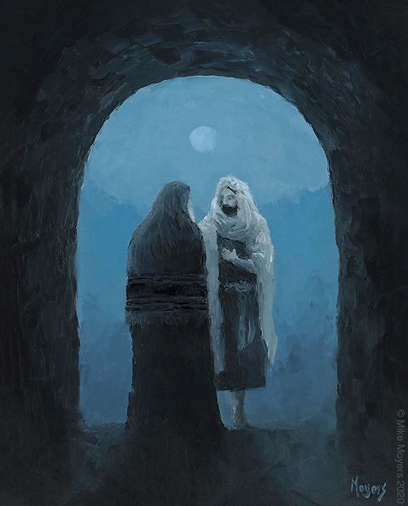
Christ and Nicodemus, by Mike Moyers
My wife Debra made her first protest sign of the Donald J. Trump Memorial Era of U.S. History almost a year ago. Her sign said: “¡THIS IS NOT NORMAL!”
Debra has held up other protest signs since. Some made by St. Paul’s parishioners for our weekly protest out on the Roy Street sidewalk from 12 to 1pm on Sundays. “Pray with Your Feet,” read one of her signs. These days, she raises a pair that say: “Jesus Was a Refugee” and “Love Your Neighbor.” I appreciate the links of those signs to our communal life of faith here at St. Paul’s. But I still do resonate with “THIS IS NOT NORMAL.” A protest sign that says it all. Clearly. Concisely. Profoundly. This is not normal! Things should not be this way!! You can read between the lines: a Department of War that lives up to its name, especially with yesterday’s attacks on Iran; mass deportations and disappeared persons; voting rights and election integrity; unaffordable or unavailable healthcare for many while the few get richer than ever; and so on.
Debra and I have also been listening to historians and sociologists interviewed on radio and podcasts. They raise questions about “This is not normal.” What is normal, after all? From what vantage point? And when? Out of whose lived experience? Robert Kagan, for instance, believes that since the end of World War II we have been lulled into a false sense of normalcy by eighty years of American world dominance and the relative peace and prosperity it has brought us. American power derived in large part from alliances with other nations, not conquest. An alignment of more-or-less liberal democratic values. But – and here’s Kagan’s point – viewed from a wider historical angle, these past eighty years have been abnormal. From the time of Napoleon in the early 1800s to that of Hitler and Mussolini in the 1930s and 40s, the normal world was one of constant competition and warfare, bloodshed and chaos, authoritarian regimes and dictatorships.
And I can’t wait to read the new book by Stacey Floyd-Thomas, African American scholar of religion and society, called When the Good Life Goes Bad, where she argues that the traditional seven deadly sins of Christianity have become the seven markers of success in America: lust, pride, greed, sloth, envy, gluttony, and wrath. These once-condemned principles now guide people’s pursuit of the good life.
This is not normal! Or rephrased a bit: the new normal in which we now live turns out to be an old normal. Which is still not normal. Things really shouldn’t be this way!
+++
Our scripture readings this morning put before us two pairs of characters. Abram (later renamed Abraham) and the Apostle Paul. Nicodemus and our Lord Jesus. Each of the four – in different ways – could hold up the sign, “This is not normal.” If not as protest, then at least as descriptive of their story. And I think their stories are more relevant today than ever, and I do mean today.
Abram the archetypal immigrant. Go from your country and your kinfolk and your parents’ house to the land I will show you, God says to him. Away from everything and everyone and every place you’ve known, out into the unknown. A journey. An escape? A new beginning? Abram’s flesh and blood descendants are called “the Hebrews” – ivrim – which literally means those who crossed over. But his new name “Abraham” promises more: the ancestor of a great multitude of different peoples. Did you hear it in his story? Abram, leave behind home and everything you call familiar and go to that foreign country to be a blessing to others, not just for yourself. A blessing to all the families of the earth. This is not normal!
What then are we to say was gained by Abraham, asks the Apostle Paul? Paul a descendant of Abraham according to the flesh. A rabbi, a teacher, a scholar of the inherited wisdom of his Hebrew people. Paul’s journey is theological, spiritual, even racial and ethnic. Paul has to let go of an entire worldview and embrace a new one – which turns out to hold fast the deepest and truest meaning of the old. What was gained by Abraham? What does the story of his immigrant journey into the unknown mean for Paul and the diverse people – both Hebrews and Gentiles – he meets in the cities of Asia Minor and Greece? That Abraham is the parent, the ancestor of us all, not just Paul’s own racial/ethnic/religious group. For, Paul writes, Abraham’s greatness comes as pure gift from God. Not an entitlement. Not something transactional that Abraham manipulated for his own image and enrichment. Not something due to Abraham because of his own actions, his accomplishments. God’s promise to Abraham belongs to all people by faith, Paul concludes. Abraham the homeless immigrant blessing many, many nations. Not normal!
There was a Pharisee named Nicodemus, a leader of the Hebrews. He came to Jesus by night. Nicodemus comes as a privileged insider. One of the powerful elite. Something about Jesus attracts him. Nicodemus comes as a skeptical inquirer, or maybe a cautious admirer. But Nicodemus will only come by night, under cover of darkness – afraid that association with Jesus will embarrass him or cause his social standing to slip. An elder in the religious community, Nicodemus is constrained by tradition. His identity and worldview established and certain. Or are they? Nicodemus may come by night, but against all odds he does come to Jesus. A Pharisee, a defender of the solid wall separating clean and unclean, those blessed by God and those accursed, Nicodemus shows up at the door of Jesus – friend of sinners, the demon possessed, lepers, women and children, even the dead. Highly abnormal! There’s something whispering in Nicodemus’ heart, nudging him toward a journey. Jesus, I want to live and act and relate the way you do. I want to join the community around you. I long for a new and more spacious life.
But maybe the most hazardous journey of all was the one Jesus made. A journey to the door from inside the house where he was staying. We know from Minnesota the past couple of months how dangerous it can be to open a door. But our Lord and Savior Jesus Christ opened the door to Nicodemus. In the middle of the night! For all Jesus knew, to an enemy who meant him harm. This is not at all normal! And Jesus invited Nicodemus in to sit and talk. Jesus accepts Nicodemus’ disguised and awkward questions, teasing from them hints of deeper insight. Jesus draws Nicodemus out into productive uncertainty, instead of shutting him down and closing him in with premature answers. Midwife Jesus refuses to coerce Nicodemus. Jesus honors who Nicodemus is and what he brings, even as Jesus clears space for the spontaneity and mystery of a second birth, of new life from above – born not of our flesh but God’s own Spirit. Like the wind that blows where it chooses; we may hear the sound of it, but we do not know where it comes from or where it goes.
+++
Debra has begun to wonder about what new sign she will create for the third “No Kings” protest at the end of March. I’m guessing now that the U.S. is at war with Iran, she’ll work on it sooner rather than later. For those of us who gather most every Sunday outside the front doors of this church to protest, also spend the hour talking with each other. We talk about family and friends. We talk about the Bible. About the news of the day. We talk about this parish. About other people and organizations beyond St. Paul’s with whom our values align. Even those who just drive by on Roy Street and honk or wave to us. We become more truly ourselves by being in community.
Maybe protest signs serve as places to gather community. And as we’ve learned from Minnesota, maybe the most consequential protest is simply to love and take action to care for our neighbors. All our neighbors.
Our daughter Rebekah happens to live and work in and around the twin cities of Minneapolis and St. Paul. Debra and I have heard a lot from her about this kind of neighborly protest. Rebekah also hangs out with a group of religious sisters at their little monastery north of where George Floyd was murdered. The sisters’ motto is “Live Jesus” – and they practice an open door form of monastic life. Whenever someone, anyone, rings their doorbell in that impoverished neighborhood, they open it and try to meet the person’s needs, whether physical or spiritual. Food. Something to drink. Welcome for the stranger. Clothing. Care for the sick and sick at heart. A pastoral visit to those imprisoned in any way. They also operate a school. Back in December, a few days after the Feast of the Immaculate Conception in the Roman Catholic calendar, a fourth-grade boy learned that his Mexican immigrant mother – named Concepción! – had been seized and taken away by ICE while he was in class. The sisters quickly came and gathered outside the school. Their school. Rebekah joined them. In sub-zero Minnesota temperatures, they prayed the rosary together while holding images of Our Lady of Guadalupe, only to have an ICE agent laugh in their faces. At least he didn’t shoot them like Renée Good and Alex Pretti.
After hearing that story, I realized I needed a prayer to hold my broken-heartedness and anger and exhaustion and offer them up to God. I searched until I found one by a Jewish rabbi named Annie Lewis. It has become my new sign of protest and petition and penitence, of resistance and resilience. Here are some lines from the prayer:
As parents have compassion for their children…
Have mercy on us, LORD, we are afraid.
Have mercy, we are dust. / We are made in your image.
…
Be with the children, their mothers, their fathers / who wear desert dust,
who brave desert crossings because they have no choice.
Be with the families who flee the narrow places / and find themselves stuck.
…
Save us from those who follow orders.
Save us from those with hardened hearts.
Save us from those who forget to remember
the cruelty our country holds in its bones.
…
For the sake of all that is holy, / all that is good,
open our eyes, our hearts, our gates.
Turn us around. / Return children to parents, parents to children.
Bring us to the streets. Bring us back to you.
I hold up Rabbi Annie’s protest prayer before you in the name of the God of Abraham, Nicodemus, and Jesus; the God who, in Rabbi Paul’s words: “gives life to the dead and calls into existence the things that do not exist.”
This is not normal! Thanks be to God.
Resources
Robert Kagan was interviewed on the NPR program “Fresh Air” on February 4, 2026. His article “America vs. the World” is published in the March 2026 issue of The Atlantic (but available online on since January 18, 2026).
Stacey M. Floyd-Thomas, When the Good Life Goes Bad: The US and Its Seven Deadly Sins (University of Illinois Press, 2026).
The full text of Annie Lewis’ “Prayer for Families Separated by ICE” can be found at https://ritualwell.org/ritual/prayer-families-separated-ice/