
Preached on the Third Sunday after Pentecost (Proper 6A), June 14, 2026, at St. Paul’s Episcopal Church, Seattle, Washington by Mark Lloyd Taylor, Ph.D.
Exodus 19:2-8a
Psalm 100
Romans 5:1-8
Matthew 9:35-10:23
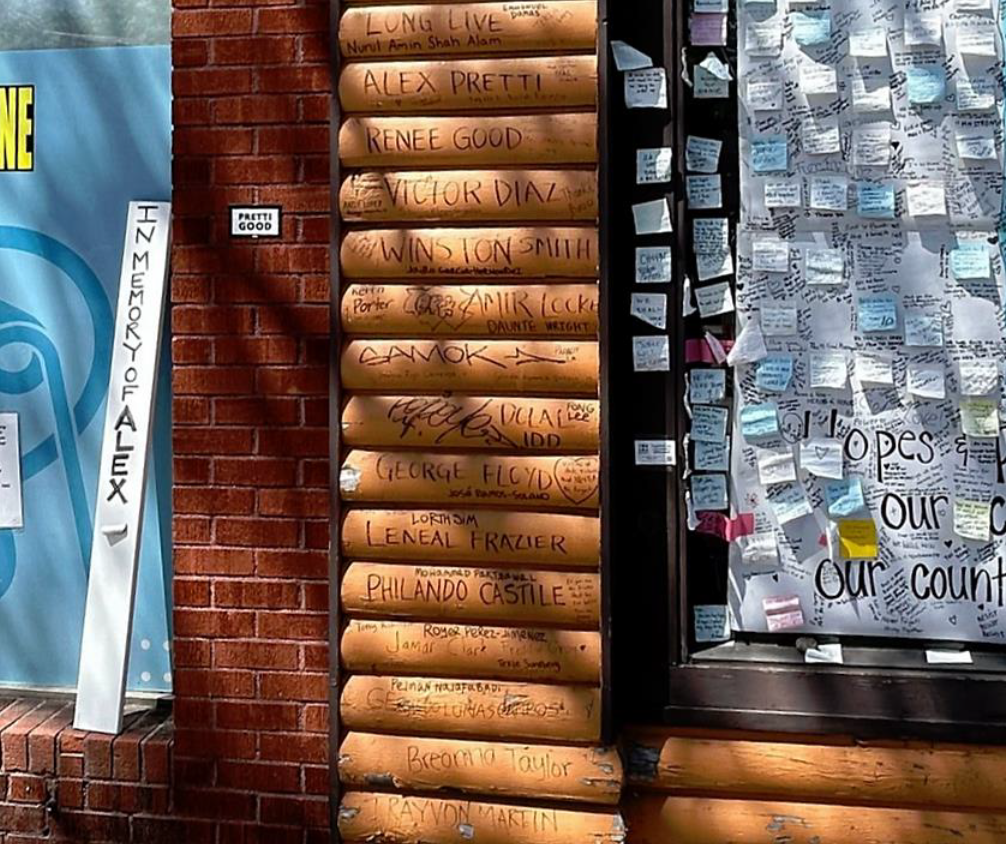
Wall of names at the Alex Pretti Memorial in Minneapolis, MN; photo by Mark Taylor
Last month, Debra and I traveled to Minnesota for a family gathering around our grandson’s high school graduation. On the airplane, I started reading Florence Knapp’s recent novel The Names, although I didn’t finish it until I got back home to Seattle. I’m a slow reader! For me, a most intriguing, thought-provoking and heart-enkindling book. I don’t want to spoil it for you, so let me just sketch the core of what you would read in the brief “Prologue” with which the novel opens (pp. 1-7).
A date: “October 1987.” Then these first words of the first sentence: “Cora’s mother always used to say….” A person’s name: Cora. A family relationship: Cora’s mother. And immediately a story. One stormy day in London, England, Cora leaves her house with her nine-year-old daughter to go to the government office and register the name of her newborn son. Cora’s abusive husband wants, no, demands that the boy be given his name: Gordon, the same name as his father and father’s father. But Cora doesn’t like the name Gordon – let alone the state of her marriage – and, instead, considers naming their son Julian, which means “sky father,” in hopes the boy might be freed from generations of domineering men to follow his own path in life. The baby’s sister Maia wants to name him Bear, “bear” as in the animal, because, she says: “It sounds all soft and cuddly and kind…. But also brave and strong.” Cora and her daughter have a conversation about the names as they walk down the street. Deferring to her husband, Cora says: “Tradition is just important to some people.” To which nine-year-old Maia replies: “Having your own name is too, though. Sometimes?” Cora again: “Wise girl.” And the reader is left outside the door of the government registry as the prologue ends.
The rest of book tells not one but three alternate, parallel stories of these characters over thirty-five years. In seven-year increments from 1987 to 2022; all anchored by what might have happened if Cora’s newborn son had been named “Bear.” Or “Julian,” instead. Or “Gordon.”
Three different names. Different life paths. Relationships between parents and children; between siblings. Grandparents. Friends and spouses and partners. Men. Men and women. Women safe in the company of other women. Places called home. Different occupations. Forms of artistic creativity. Defining choices and actions. Sickness and health. Life and death. Derision. Rejection. Love and liberation.
+++
With Florence Knapp’s storytelling in the air, hear again the core sentence of our gospel reading from Matthew this morning (10:2-4).
These are the names of the twelve apostles:
first, Simon, also known as Peter, and his brother Andrew;
James son of Zebedee, and his brother John;
Philip and Bartholomew;
Thomas and Matthew the tax collector;
James son of Alphaeus, and Thaddeus;
Simon the Cananaean, and Judas Iscariot, the one who betrayed [Jesus].
A list of names to be sure. But so much more. Birth names and those by which people came to be known. Family relationships and roles within community. Places called home. Hints about life paths.
Alternate stories, parallel even. The gospels of Matthew, Mark, and Luke all name twelve apostles. But their lists are not identical. Was the tax collector named Matthew or Levi? Simon the Cananaean or Simon the Zealot? Thaddaeus, or was it another Judas – not Iscariot, but the son of James? John’s gospel never counts to twelve, but instead features seven or nine or ten disciples and tells some of their stories more fully. In a different order. Andrew first and then Simon Peter. Philip who finds Nathanael and brings him to Jesus. Thomas; several stories about Thomas in the gospel of John. The sons of Zebedee, two others, and that mysterious unnamed person described as “the disciple Jesus loved.” Oh, and don’t forget that all four gospels make it crystal clear that in addition to seven or twelve male apostles, women followed Jesus, providing for his ministry out of their own resources: first and foremost, Mary Magdalene, original witness to the risen Christ and apostle to the apostles; Jesus’ own mother and his mother’s sister; Mary the mother of James and Joses; Mary the wife of Clopas; the mother of the sons of Zebedee; Joanna, Susanna, Salome, and many other women, named and unnamed, each with her own story.
But back to Matthew’s account of the twelve apostles. Why did Jesus call them? Because Jesus needed help, needed companions in order to do his work, to become himself in his fullness. Jesus was making the rounds of the cities and villages of Galilee. Teaching in synagogues, proclaiming the good news, and curing every disease and every sickness. When he saw the crowds, he had compassion for them, because they were harassed and helpless like sheep without a shepherd. Jesus the Good Shepherd needed to bring other shepherds alongside. The harvest was plentiful, but the laborers few.
So, Jesus gathered the twelve and sent them out. “Apostled” them, for the word apostle just means sent. Sent to support and extend Jesus’ own mission. He gave them authority over unclean spirits to cast them out and to cure every disease and every sickness. Exactly what Jesus was already doing. Jesus sends his twelve apostles with these instructions. As you go, proclaim the good news: God’s kingdom has come near. Cure the sick, raise the dead, cleanse the lepers, cast out demons. But also with warnings. Beware! I am sending you out into the midst of dangerous predators. Be wise as serpents and innocent as doves. The same innocent wisdom and wise innocence Jesus demonstrated throughout his ministry. You will be handed over to councils and flogged even in religious institutions and by their leaders. You will be dragged before governors and kings. Just as Jesus was. You will be hated because of my name. Another name. As if Peter and Andrew, James and John, and all the rest can, should, must be known by a new name: the name of Jesus. Because the twelve did not go out in their own names to enrich themselves. “You received without payment,” Jesus says; “give without payment” (10:8).
Not just the twelve men Matthew names, but also those mentioned in the lists and stories of the gospels of Mark, Luke, and John. Including the many women: Mary Magdalene, the other Marys, Joanna, Susanna, and more. All sent. All “apostled” in the one name of Jesus. And it doesn’t stop there. We can, we should, we must add our own names, because we too, each and every one of us, is called by Jesus through baptism and sent out to support and extend Jesus’ mission in this world. Father Stephen [at 8:00am] / Mother Catharine [at 10:30am] prayed earlier on our behalf that through “grace we might proclaim God’s truth with boldness and minister God’s justice with compassion; for the sake of…Jesus Christ” (BCP, 230). Bold compassion and compassionate boldness. Proclaim the good news of God’s beloved community liberated from racism, misogyny, and homophobia. Cure those sick in body, mind, and spirit. Raise structures of social/political/economic justice that have become as good as dead. Cleanse those, welcome those, who like the lepers of Jesus’ day have been shoved outside the bounds of human dignity. Cast out the demons of addiction to alcohol and drugs, but also to power and selfish pleasure. Peter and Andrew. Philip and Nathanael. Mary Magdalene and Salome. Stephen and Catharine. Carol and Esme. Phelps and Jenny. BJ and Chris. Add your name to the list. Your birth name or the name you adopted later. Add all our names, knowing these are just some of the names of Jesus’ apostles.
+++
A few of our many companion apostles have come to be known with a title added to their names: Saint. Saint Peter, Saint Mary Magdalene, and so on. Originally in Christian scripture, the word “saint” referred to all members of a Christian community. But within a few hundred years, “saint” takes on the narrower meaning of an exemplary follower of Christ. The saints are given an annual feast day on the liturgical calendar: Saint Brigid on February 1, Saint Andrew on November 30. Churches are dedicated in their names: St. Luke’s Church in Ballard, Saints Hilda and Patrick in Edmonds, Saint Clare of Assisi in Snoqualmie. The saints did not emblazon their own names on buildings or arches or promenades. Nor did they celebrate their birthdays with shows of ritualized violence against others. In fact, the first Christ followers singled out and honored as saints were those we would call the “martyrs” – those who, as Jesus warned, were hated and hunted and killed because of Jesus’ name. And the places where they died came to be lovingly attended as holy – where heaven and earth, the divine and the human, come together. Even though in both Hebrew and Roman culture the remains of the dead were considered ritually unclean, early Christians set up memorial shrines at these places, with relics of the saints in or under their altars, where the meal of Christ’s body and blood was shared.
With this in mind, on our last full day in the Twin Cities, Debra and I made a pilgrimage to the memorials of Renee Good, Alex Pretti, and George Floyd, all located within the same seven-square-block neighborhood in Minneapolis. The places where they had been killed by agents of our own government in the name of our would-be kings. We visited the three shrines on “Memorial Day,” May 25, the day after Pentecost, which also happened to be the sixth anniversary of George Floyd’s death. These holy places were lovingly tended. With photographs and drawings. Written tributes. Flowers. Ribbons. All sorts of physical mementos. But at each specific place of death of each of these three specific persons: Renee, Alex, and George, other names besides theirs were visibly present. A fence of names at Renee Good’s shrine. A two-block long street of names painted on the asphalt leading to George Floyd’s. And at the Alex Pretti memorial, a log-cabin-style wall with names inscribed on the wood. A wall of names. Alex Pretti and Renee Good near the top. George Floyd in the middle. Breonna Taylor and Trayvon Martin toward the bottom, with many others in between. Above these names, however, another wooden log reads: Long Live. Is this a prayer? A confession of faith? An echo of the angel’s announcement to Mary Magdalene and the other women at Jesus’ tomb? “He is not here, for he has been raised” (Matthew 28:6).
+++
Florence Knapp’s The Names ends with an “Epilogue” in which we rejoin Cora and Maia inside the government registry office with the newborn baby boy. When asked by the registrar what Cora wants to call him, another name, a fourth name suddenly occurs to her. Not Gordon. Not Julian. Not Bear. A new name, one I will leave unsaid for you to discover. And with that name, an untold story beyond the pages of the novel.
This epilogue is dated July 29, 2022 – after the thirty-five-year span of the three alternate, parallel life stories anchored by the original three names. Now this is my observation, not Florence Knapp’s, but July 29 in our liturgical calendar is the feast day of Saints Mary and Martha of Bethany who grieved the death of their brother Lazarus and lovingly tended his remains, only to have Jesus call him forth from the tomb to new life. July 29 is also the anniversary of the first ordinations of women to the priesthood of the Episcopal Church in 1974, a group of women known as the Philadelphia Eleven. Proclaim the good news of God’s kingdom. Cure the sick. Raise the dead. Cleanse the lepers. Cast out demons. Or, to bring a few last words from The Names here, today, into this holy place – St. Paul’s Church: “the air quivers with unspent possibilities of how else [our] fates might become untied, what other paths [our] lives might [now take]” (p. 314).
________________________
Resource
The Names is Florence Knapp’s debut novel (New York: Penguin Press, 2025).