
Preached on the Second Sunday of Advent (Year A), December 7, 2025, at St. Paul’s Episcopal Church, Seattle, Washington, by the Reverend Samuel Torvend.
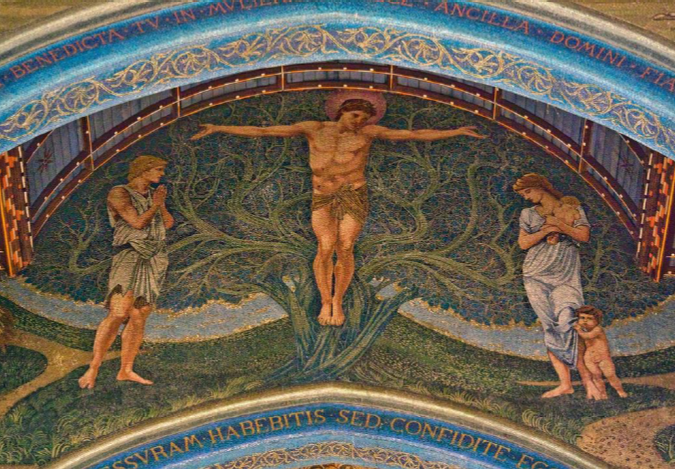
The Tree of Life, by Edward Burne-Jones, St. Paul’s within the Walls Episcopal Church, Rome, Italy
Let me say that it doesn’t take a genius to recognize that John the Baptist was not pleased with the way things were in his world. I mean you don’t call people a brood of nasty slithering snakes – vipers – if you’re in a good mood and all’s well with life. After all, John lived under a ruler who was an abusive womanizer, a paranoid and narcissistic leader who ordered the deaths of three of his children, a collaborator with the Rome Empire and its colonizing ambitions, a spreader of disinformation, and the king who ordered the crushing of any dissent with violent police force. [Does any of this ring a bell?] John knew that the land in which he lived was given to the Hebrew people by God and that Roman military occupation of that land with its worship of foreign gods was utterly blasphemous. And this, too: John held that religious leaders in Jerusalem were corrupt in their collaboration with Rome and their demand for a religious tax that the majority of the population – poor peasants – found difficult if not impossible to pay. Thus, when John announces that there is “wrath to come” and that “the ax will fall,” he is hoping that God will come – that God the liberator will come and at last clean up the incredible mess in which John and all Israel lived.
Needless to say, John the fiery preacher was no life coach urging his listeners with that tiresome cliché to become the “best versions of themselves.” He was no friendly soulmate who gently urged a bit of improvement to one’s supposedly decent life. The time in which he lived – in many respects so similar to our own chaotic and topsy-turvy era – demanded a sweeping change in which the chaff – the dry and useless husk of grain – would be burned to a crisp. Indeed, John announced that when God begins the process of cleansing this messed up world, “every tree” – that is, every person – “[who] does not bear good fruit will be cut down.” Let me say: this is no cocktail-quaffing-anyone-for-tennis preacher. John expects, longs for, a radical change: radical from the Latin radix, meaning at the root. The old way must be uprooted, says John, so that the new might appear.
Thus, when John demands repentance, he is not concerned with the petty sins of life. Rather, he is asking people to change their minds, to go in a completely new direction, to wash away an older and presumably satisfactory way of thinking and acting – something that the privileged of his world and perhaps of ours – would resist. After all, who wants to change what appears to work? I’m mindful of the Russian nobility who in 1917 sipped vodka and ate piles of caviar in grand ballrooms as impoverished peasants and downtrodden workers joined the Bolsheviks in a revolution that changed the world. John is not interested in modest renewal: only a thorough clean-up will bring about a measure of justice and peace.
But then, but then, here’s the surprise, the unexpected thing that John himself could not have imagined: for when the Expected One comes, whose name is Jesus, he does not – he does not share his cousin’s cataclysmic rhetoric of the ax felling every tree at its root. Rather, if you can believe it, he allows himself, a young sapling as it were, to be cut down, cut down in an early death. That is, he enters our world in solidarity with any and all who suffer from the predations of corrupt rulers or life-threatening disease, with those who experience loneliness or anxiety. He enters this world – our world – as a companion with any and all who wonder if their life has any meaning, any purpose beyond making a wage and paying the bills. And he does so – not with the threat of more violence, with more trees chopped down – but rather with an alternative to the rhetoric of condemnation: that soul-numbing rhetoric which presently suffuses the news we hear and read on a daily basis.
My friend, Susan Cherwien, of blessed memory, whose lyrics we have sung in this church, created a hymn text most apt for these Advent days. She writes, “Who was, who is, and is to come as servant lived in human sphere. Compassion was his diadem, his glory was the gentle tear; humility, his purple garb; and healing hand, his royal orb. Such love – such love – drew ire and ire drew death.” You see: John expected the ax to fall and so it did. But it fell on Jesus who offered another way of living in this world: not with brutality but healing, not condemnation but compassion, not arrogance but humility, not retribution but mercy. It was this other way of protesting the injustice and corruption of the world that drew ire, that is, drew anger and thus his death: his death on a tree – that which we see so clearly before us in this house – Christ crucified on the wood of the tree, the sacrament of God’s loving solidarity with the insults and injuries of life, of your life and mine and the lives of those who will never pass through the doors of this household.
And yet, and yet for us, the unexpected has happened: for the tree of death has become the tree of life. For we recognize that the One who was cut down by the cruelty of empire is the Living One, the living tree who grows out of the cut-down stump, who is raised from the tomb of death into unexpected life: raised, if you will, into your life and mine. Dear friends, it is into this life-giving tree, this wounded yet Living One that we have been grafted in the waters of Holy Baptism and nourished with the sap of his blood in the Holy Eucharist.
And so, having been united with him, let me say that there is hope in these Advent days: hope that you and I, his living Body in the world, just might continue his work to seek justice for the poor and defend those in need; that we might chose to act with mercy rather than retribution, with humility rather than arrogance, with compassion rather than condemnation. Indeed, there is hope, when, from our treasure or our time, you and I feed the hungry, clothe the shivering, care for the sick, welcome the stranger, and protect the immigrant. For in these actions, we contribute to the growth of the tree of life whose name is “The Lord our Justice,” whose name is Jesus.