
Preached on the The Last Sunday after Pentecost: The Reign of Christ (Year C), November 23, 2025, at St. Paul’s Episcopal Church, Seattle, Washington, by Jon Achee.
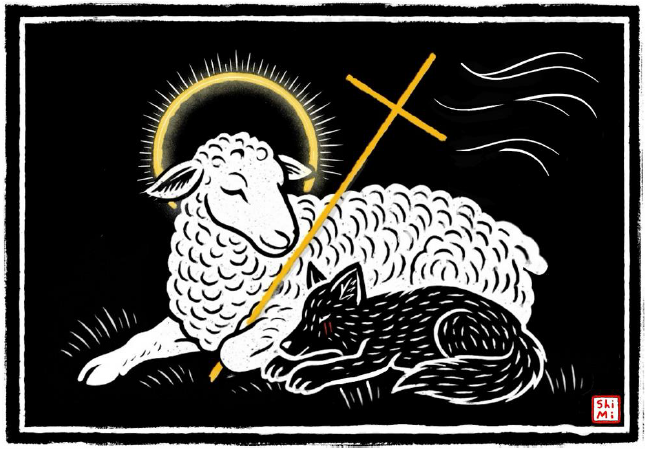
The wolf shall dwell with the lamb, by Claire Fox aka Shimi
A prayer from Richard Rohr:
God, Lord of all creation, lover of life and of everything, please help us to love in our very small way what You love infinitely and everywhere. We thank You that we can offer just this one prayer and that will be more than enough, because in reality everything and everyone is connected, and nothing stands alone. To pray for one part, is really to pray for the whole, and so we do. Help us each day to stand for love, for healing, for the good, for the diverse unity of the Body of Christ and all creation, because we know this is what You desire, as Jesus prayed, that all may be one. Amen
Last Tuesday night I met someone’s child on Broadway in the Capital Hill neighborhood while walking with the street ministry of Nightwatch. For over a year now, I have joined with the Nightwatch street ministry leader, Pastor Michael, and maybe one other volunteer, and we drive up to Broadway on Capitol Hill on Tuesday evenings with canvas bags filled with bottles of water, snacks, socks, gloves, beanies and Narcan. We simply walk Broadway and the nearby streets and parks for a couple hours and stop to talk with any individuals or groups we encounter that we suspect might want something in our bags, and more importantly might want to just share a connection with another human being. We are just like the St Paul’s folks who pull the SPiN wagons through this neighborhood. We never push ourselves or the supplies we have on anyone. We simply ask “Hi, we are from Nightwatch, can you use some socks or water?”. This simple question sometimes leads to no reply and we move on, or a yes but without any further desire to interact after receiving something out of our bags. Sometimes, however, this simple question leads to conversations and shared communion over difficult stories of abusive partners or parents, health problems, street sweeps, friends going through a difficult time, or run ins with others on the streets that have led to a loss of possessions, a tent home or injury. Living on the streets is a constant struggle. However, we also hear joyful stories of a book of poetry that is being published, some artwork created and sold, a friend taking care of another, a mother excited to give birth in just days and finding pre and post-natal care, an improving golf game practiced in the early evenings after the golfers have left the links, an upcoming job interview or the possibility of a new shelter opportunity. Stories of past lives working in New York theatre, of marriages and children, or the sadness for a missed mother who lives in Los Angeles. Whether a story of suffering or joy, the unexpected connections stay with me long after the encounter. Every story is given grace and respect, as we have learned over time that some of the stories are true.
Now I don’t speak of the experience of Nightwatch as a ministry that works for all, and hopefully you do not hear me patting myself on the back for “doing good deeds”. Walking the streets at night can be uncomfortable and scary. You can lose sight of the loveliness of connections and the building of community under the burden of encountering folks experiencing a full mental crisis or bent over in what I call the “fentanyl slouch”, completely lost to themselves and the world. It is especially challenging for me when so many of the folks I meet are the age of my own children. Then I am forced to confront the difficult reality that except for some seemingly small twist of fate, a fork in the road where they went right instead of left, some systemic inequality, bias or hatred they faced, or simply a lack of support or more tragically a lack of love, someone else’s child is in front of me on Broadway, while my own children are safe in their homes and lives.
Walking into this liminal space between “the already and yet to come” one must honestly confront the question, where is God in all this? To confront the desire at times to blame the person in front of me for their current condition and thus getting wrapped up in the justification of their suffering instead of remaining focused on just drawing alongside them in their suffering. Be it only for a brief terrible and beautiful moment while we are in communion on the streets of Capitol Hill. A desire, the sin, to break the relationship with those suffering, and to not bear witness and to forget how we are called to respond to our often messy and frustrating world by the God incarnate in Jesus, whose kingship we celebrate today on the Feast of the Reign of Christ.
How do we respond to the Christ that we proclaim as Sovereign today? A King that allowed himself to suffer death at the hands of empire, and rule from a cross and not the comfort and safety of a throne?
In the letter to the Colossians, we learn of this odd King, “in Him the fullness of God was pleased to dwell, and through him God was pleased to reconcile to himself all things, whether on earth or in heaven by making peace through the blood of the cross.” This Scripture makes clear we follow and profess a King that seeks reconciliation in the messiest places of humanity. A God incarnate in Christ willing to take human form and meet us in the middle of our darkest places when we at our worst. Willing to endure the suffering, the blood, the gore of an empire’s execution. We can not only believe, but we can trust that we will find Christ in the midst of our own suffering. In fact, Jesus is calling to us from the suffering to provide the confidence that we can and must step into the challenges we confront in our world knowing that we will find God in Christ right there within the messiness waiting for us. God always seeking reconciliation and relationship with us. This is the beauty of the “the already and not yet” place, the liminal space that can feel so discomforting, a space of uncertainty and even suffering at times, but we can trust that Christ our Sovereign waits for us there.
In the Gospel from Luke, we find Christ the King at the moment of their own deepest suffering on the cross still working for reconciliation with us. Instead of a royal decree the Sovereign Christ says, “Father, forgive them for they do not know what they are doing.” In this dark and terrible public moment, we witness Christ our Sovereign reject the catcalls of the leaders and soldiers in the crowd saying that he could just remove himself from human suffering. Instead, Christ remains in the mess and blood of the cross, demonstrating that only the power of love, grace, and reconciliation, can build a Kingdom where everyone flourishes. We find a King hanging on a cross between two suffering criminals offering mercy and grace to the criminal who prays for these things. This gift of mercy and grace in the midst of all the suffering is not promised sometime in the future, but today and right now, in “the already, and not yet” as Christ tells his companion in shared misery, “Truly I tell you, today you will be with me in Paradise”. Oh yes, we can be loud and grateful in praise for a King who will meet us within the suffering and joys of our lives only looking for relationship, and offering unending reconciliation, love and grace. A King who delights in the flourishing of all people and creation. This is the Good News!
However, and you knew there had to be a however, more is asked of us than just praise. Getting back to my earlier question, how do we respond to Christ we proclaim as King? There are a couple ways that seem appropriate to me beyond just praise. First, we must respond in trust. I know this is not easy in our current society where we are suffering from a crisis of trust, but we must know and trust that God through the incarnate Christ is waiting for us there in the midst of this doubt. Secondly, we must have the confidence that we will find God in the midst of the suffering, that God meets us within our lived realities. The trust and confidence to keep doing the work to alleviate the suffering in the world. Let our first response not be to justify the suffering, our to simply walk past it as the religious leaders did in the parable of the Good Samaritan, but to reach out in love to alleviate it. Walking alongside Christ on every Broadway we walk, in all our relationships, working for love and reconciliation with all people and all creation, especially those that might be suffering, economically oppressed, or facing injustice. No questions asked.
Last Tuesday, while walking Broadway with Pastor Michael, I asked him, how do you keep coming out here week after week over so many years, knowing you will most likely find the same level of suffering? How do you stay so positive? After talking about the need to bear witness and to provide comfort, he said, because this is my community now. The folks out here are always first to ask me how I am doing, and what my kids are up to. When I am at a dinner with church people feeding these folks, it is always the street community that makes me feel most comfortable and loved. How can I not love them back?