
Preached on the Third Sunday of Easter (Year A), April 19, 2026, at St. Paul’s Episcopal Church, Seattle, Washington by The Reverend Stephen Crippen.
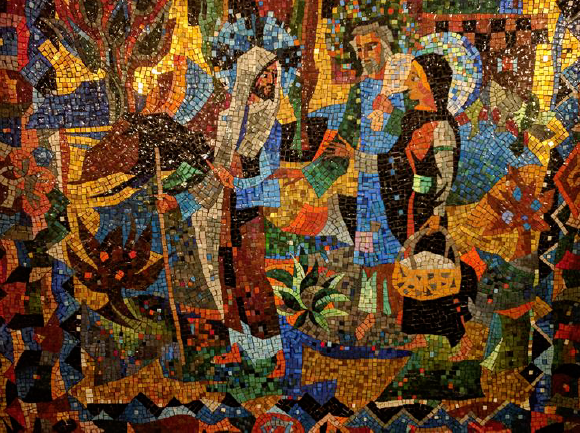
Third Station of the Resurrection: The Walk to Emmaus (detail) located in the National Cathedral, by Rowan LeCompte and Irene Matz Le Compte
More than forty years ago, Minnesota Governor Rudy Perpich named my father to the new state Court of Appeals. Since it was a newly formed court, the governor got to fill the whole bench. My dad was an intentionally regional choice: the governor needed a judge from the southwest corner of the state.
I remember that there was a long delay in the appointment, until finally my father made clear to the governor’s office his interest in the job. When he met with the governor, he asked about the delay. I don’t know how he broached the topic. “Why the delay?!” he could have blurted, but my father was never forward or direct in that way. He did not strut. But somehow he managed to ask the question. Governor Perpich replied, “Because you hadn’t asked me.”
Sometimes the person we want most to be here, or the person we want most to do something, is absent or reluctant only because we have not asked them to come; or we have not asked them to take action.
We shouldn’t miss this detail in Luke’s marvelous telling of the Walk to Emmaus. The risen Christ appears to his followers, and specifically he becomes recognizable to them in the breaking of the bread (more on that in a moment), but they do not recognize him before they ask him to stay with them: “They urged him strongly, saying, ‘Stay with us, because it is almost evening and the day is now nearly over.’ So he went in to stay with them.”
This little detail in the narrative inspires me to moan and cry out with desire: O Risen One, O Lord, O Savior of the World, stay with us! If it’s just a question of being asked — if all we need to do is ask — then please, Jesus, come and stay with us!
How profoundly we need our risen Savior right now! Last week I finished a book by the late Thomas Cahill, an historian who wrote in the popular vein, a book called Heretics and Heroes. Cahill chronicles a busy, restive European age, roughly the fourteenth through the sixteenth centuries. I never before appreciated how brutal and bloody the Reformation era was.
Here is a passage of Cahill’s book that has me reflecting on how badly we need our Savior, a need we have felt for centuries now, if only to save us Christians from ourselves. Cahill writes:
“[During the Renaissance and Reformation,] the occasional conflict of Christian against Christian progressed swiftly to bloody regional clashes and thence to unforgiving national wars, a state of affairs that Europe would hardly attempt to forsake till the bleak period of unavoidable reflection that would follow the global disaster of World War II. Let’s draw our swords and kill all the Others — all the heretics, all their spouses, all their children, for all [of] these are hopelessly compromised by their invincible wrongheadedness and their perverted commitments. No epitome of the conflicts that wracked Europe from the 1560s to the middle of the seventeenth century could possibly account for the needless suffering that men inflicted on their fellow men and on the women and children trapped in these hostilities. So I shall not try.” (End quote.)
Bloody century after bloody century, we Christians have warred with one another; we have raged against those whose faith is other than Christian; our faith has formed the headwaters of rivers of blood. All of the promises of the Enlightenment and the modern era; the heady post-war decades that gave us the United Nations and a new vision for fundamental human rights; the awesome advances in medical science and technology that extended human life expectancy and improved public safety — none of these has prevented Christians from drawing upon our faith tradition to rationalize brutality that destroys human life, other creatures, the earth, the air, the seas.
O Risen One, O Lord, O Savior of the World, stay with us! If it’s just a question of being asked — if all we need to do is ask, then please, Jesus, come and stay with us! If we but ask, he will come into our lodging place at the edge of town, in the evening, and he will sit at our table.
But we won’t know who he really is, we won’t understand him, we won’t grasp what he is teaching, we won’t have any hope of following him, until he breaks the bread: “When he was at the table with them, he took bread, blessed and broke it, and gave it to them. Then their eyes were opened, and they recognized him.”
This is what so many Christians, millions of Christians, have missed down the ages, and now. This insight is lost on a politician who posts an image of himself as Jesus, with symbols of war unironically hovering around him. This is what we will miss if we don’t stop, breathe, listen, watch, and let it sink in: “He took bread, blessed and broke it, and gave it to them. Then their eyes were opened.”
The bread breaks, and in the breaking, becomes food for everyone. The bread breaks, and in the breaking, sends fractures through our set assumptions, cracks open our closed minds, breaks into pieces our safe prejudices, rends asunder our proud hearts. To be Christian is to be broken: broken down from the heights of arrogance; broken open to encounter our troubling neighbor; brokenhearted by the fate of all the innocent dead.
Maybe you’ve wondered about the solemn, quiet moment when the priest takes the consecrated bread, holds it aloft, breaks it apart, and stands there quietly, her face averted. (We are not to lock eyes with the priest at this moment: the breaking of the bread is not about her, or us. It is all Christ.) We call this moment in the mass the “Fraction,” as in fracture. An upsetting crack snakes through our solid walls of certitude and confidence. The consecrated bread breaks. And in that crisis, right there, we recognize the Risen One.
Remember that he breaks the bread with wounded hands, with a body torn open by injustice, a body fractured by his solidarity with the oppressed. And so the terrible, atrocious, dreadful, sick irony of Christian violence down the ages is that when we spill human blood, we move away from our Lord, we push him out of our house, we kick him back onto the road, and he walks on.
But all of this is a hard teaching, for all the fact that it is shot through with the breathtaking joy of Easter. If I stay safe from you, and don’t allow my heart to be broken open to you, then I will not recognize the Risen One. If we shut up our doors from human suffering, and refuse to be fractured by the mercy of God, we will never be a haven for the weary, and we will never commune with the One who triumphed over sin and death. The bread must break; we must break; the wounds of the Crucified One must become ours.
And I can tell you, and our many companions here can tell you, this hurts. Four of us went on a SPiN walk last Sunday, and we (like Cleopas and their companion) encountered strangers on the road. Two people in particular were suffering from untreated mental illness, which is all too common on the streets of this wealthy country. We could not save them; we could not fix them; we also could not abandon them. We could only be fractured by them. We bore witness to their pain.
It felt like too little — it was too little — to just hand them soup and a pair of socks. But we try not to stop there. We pray for the courage to be broken open by our encounters with our Uptown neighbors. On these SPiN walks to Emmaus, everyone is greeted as hungry humans, by hungry humans. We receive the painful gift of intimacy and solidarity with companions deeply wounded by our own government, our tax dollars, our national culture.
These encounters have the power to restore our humanity, if we allow them to do so. And they inspire ever more encounters in our parish life, on our parish mission. Some of us fill our pantry shelves, a ministry that announces Resurrection just as the Risen One does: as Cleopas has taught us, resurrected life is found around a dinner table. Some of us break bread with the sick and the dying. Others tend to our youngest missioners in the children’s chapel. Some of us walk in protest alongside hordes of activists and advocates. You, in your vocations of family life, work life, and civic life: you, too, can be broken open by the bracing news of Resurrection.
In all of these labors of love, our hearts burn within us. And when we cry out for our risen Savior, singing to the sky our desperate plea that he stay with us, we will find him right here, at this Table, recognizable in the broken bread. His presence fires us with hope and floods us with joy, giving us new life in his Name.
But it also breaks us, badly, and that hurts.
It hurts like a grievous wound.