
Preached on The First Sunday after Pentecost: Feast of the Holy Trinity (Year A), May 31, 2026, at St. Paul’s Episcopal Church, Seattle, Washington by The Reverend Samuel Torvend.
Genesis 1:1-2:4a
Psalm 8
2 Corinthians 13:11-13
Matthew 28:16-20
The adult child of a former parishioner who had died sat across from me as we began to review the selections of hymns and biblical readings she and her sister had made for the funeral Mass. “Well,” she said, “we don’t want to start with any Christian hymn or the resurrection anthems in the prayerbook. We want a good friend, who is a talented musician, to sing Frank Sinatra’s ‘I did it my way.’” I took a deep breath and said, “Your friend would be most welcome to sing Sinatra at the reception but as this is a Christian funeral in the Anglican tradition, we sing only Christian texts during the Mass. But I’m wondering: why ‘I did it my way’?” “Our father,” she said, “did everything on his own, did it his way, and was an enormous success because he did it his way.”
At that moment, I thought to myself: I don’t think that’s true. None of us have “done it on our own.” I mean I don’t think about it much but my parents had to have sexy time for me to enter the world. I mention the simple fact of my conception because I reject the notion that I am a self-made person, a mythology largely embraced by middle and upper class Americans. No, I did not create myself and when I think about my life a good many decades after my birth, I know that I continue to bear not only the genetic imprint of my parents but also the values and practices with which I was raised. I am not alone. You see me standing here but I am a community of more than me. I did not do it my way, but rather our way. I was and still am shaped and supported – as I hope you are – by many people.
In my first year of teaching at PLU, an earnest student from a conservative evangelical background stopped me after the first day of class and asked me if I had accepted Jesus Christ as my personal Lord and Savior. For a moment I was startled by his question since I was hired for my expertise, not my religious beliefs or practices. In response, I said to him, “I appreciate your concern - but I have to say your question is just too small for me.” “Too small?” he asked with an equally startled look on his face. “Yes,” I said. “For you need to know that the God I worship is larger than one person; that the God I worship is a community - you might say, a communal God.” Well, that brief exchange led to a lengthy discussion, one that invited this student to stay with the course and enter, for the first time in his life, the mystery of the Holy Trinity and how that core Christian conviction could actually expand one’s understanding and experience of life on this earth with other human beings.
You see, the temptation is ever-present in American culture to simplify, to reduce to easily-digestible terms just about everything, a practice largely shaped by the advertising industry in which a commercial for a product or a service runs on average 20 seconds. Week after week, and month after month, and year after year of exposure to short and simplistic ads as well as news broadcasts geared toward a fifth grader’s level of comprehension will shape one’s understanding and expectations of just about anything, including religion.
It should not surprise us, then, that a simplistic form of faith is quite popular among a good number of Americans. The problem is this: the desire for an uncomplicated form of faith usually goes hand-in-hand with a desire for absolute certainty - and the desire for absolute certainty can easily lead people to seek an unquestioned authority. My student wanted absolute certainty from me; he did not want questions that just might expand his thinking about life. Here’s the point: Christian faith and life are more interesting and so much richer than simplistic formulas and easily-digestible slogans. Honestly, if that’s what you seek, there are plenty of churches who will provide it. But not here. For at the heart of Anglican spirituality is a willingness to engage the complications and the richness of our lives lived with God, refusing to reduce God and our lives to saccharine stories and safe sound bites.
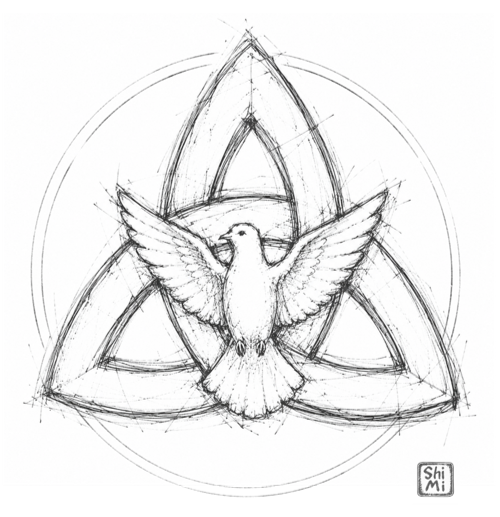
Which leads us to the feast of the Holy Trinity and why a host of people - from feminist theologians to Black preachers - find in our communal God a helpful way of expanding, rather than diminishing, our experience of life on this earth with other human beings. As a child, our Sunday School teacher used a triangle within a circle to teach us that “the Father is not the Son and the Son is not the Spirit and the Spirit is not the Father and yet they are united in mutual love for each other.” Little did we know that such a fairly simple proposition would develop into the far richer notion that there is diversity in our communal God and that such diversity is witnessed everywhere in the creation and that such diversity is the norm, not the exception in life.
Well, we’re on the eve of Pride Month: indeed it would be hard to miss the Pride flag hanging on the exterior of our office wall, indicating that this is a safe and welcoming space for a minority in American life. A newcomer to St Paul’s recently asked me why Episcopalians make such a big deal of inclusion, of welcoming people from different identities and backgrounds. “Aren’t you just trying to be politically-correct?” he asked with a hint of skepticism in his voice. Uh, no, I said. We aspire to welcome the diversity of human experience because we are baptized and communed in the life of a communal God marked by difference: the Son is not the Spirit and yet they live with love for each other. And that is who we hope to be as a parish community: a visible, breathing, and tangible image of our diverse and loving God.
Now that sounds like nice greeting card sentiment - “We’re diverse and loving” - except for this: there are powerful voices and equally powerful legislatures in our nation that are working diligently to divide and exclude people from each other, censoring the literature available for reading, and demonizing people who don’t conform to one particular identity. So let me say this as clearly as possible: it is no small thing, dear friends, to celebrate this feast of the Holy Trinity and what it suggests for how we live with each other, especially those others who may be different from you and me. For in the communal God who is the creator of various and wondrous lives, there is no demonization, no exclusion; there is only love. And so I wonder: Can it be any different for you and me?
I say: All praise be the holy and life-giving Trinity, now and forever. AMEN.