
Preached at the Requiem Mass for Prudence C. Kluckhohn, January 24, 2026, at St. Paul’s Episcopal Church, Seattle, Washington.
Lamentations 3:22-26, 31-33
Psalm 121
1 John 3:1-2
John 10:11-16
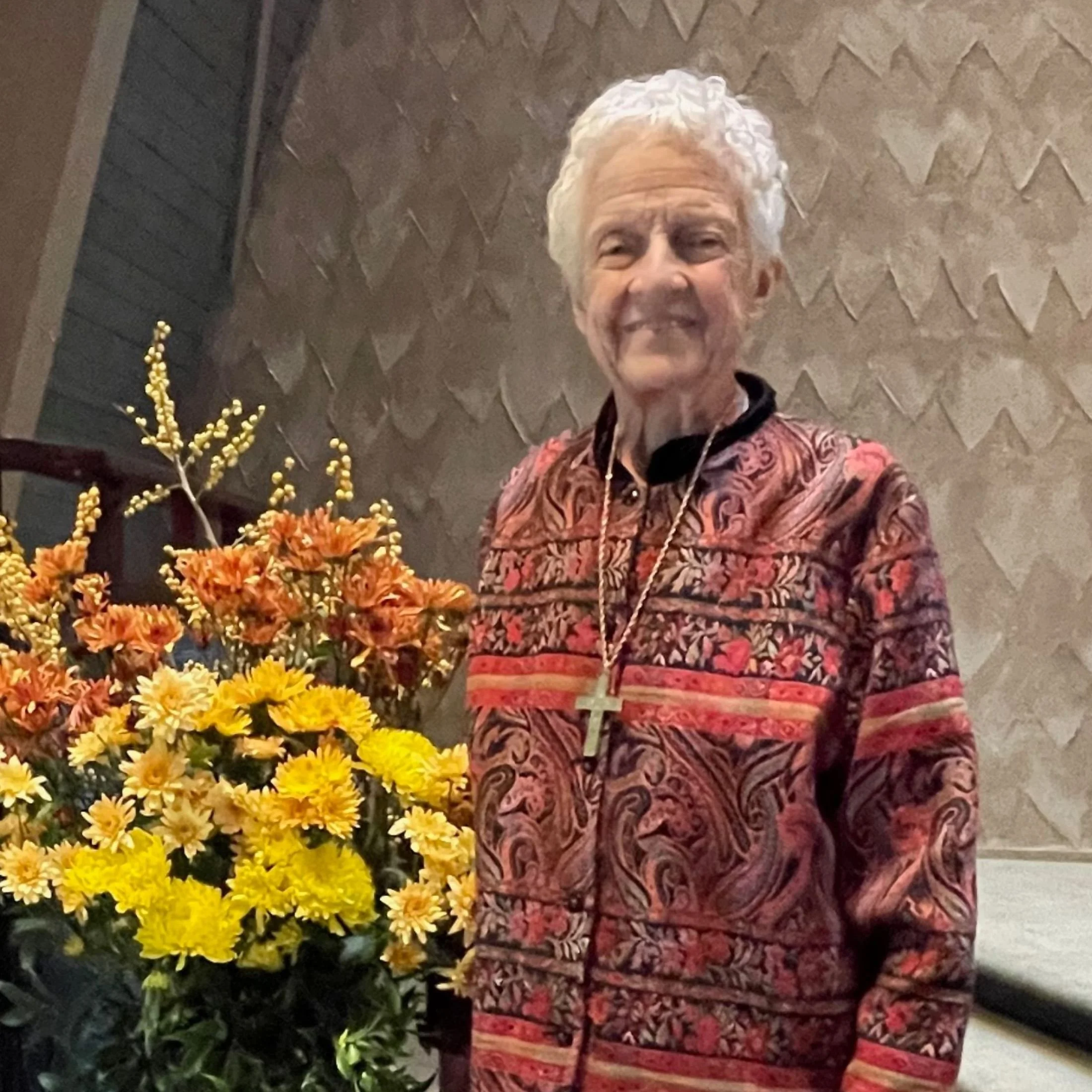
Prue recently got a new car. She never really got to enjoy it. It is a sad irony that the most unfussy and practical person that any of us has ever known did not have a chance to enjoy a shiny new car in her twilight years.
Prue wore fun t-shirts that played on words. One of our best photographs of our sister in Christ has Prue in a Seattle Aquarium t-shirt with a Star Wars theme, “The Otters Strike Back.” It is a funny irony that one of the most serious and missional Christians that any of us has ever known was famous for her quietly playful, self-effacing silliness.
Prue lay on her deathbed holding the golden gift of self-aware wisdom and the majestic power of love for God and neighbor. It is a lovely irony that the person who has done more ordinary, menial tasks for this community than anyone we have ever known was given a holy death of the kind we read about in the lives of the saints.
The Cappadocian father Gregory of Nyssa, brother of Basil the Great, remembered his older sister Macrina’s holy death with great solemnity and awe. Filled with the Holy Spirit until her last breath, Macrina reflected insightfully on the human soul and on the Resurrection, and then she died in the peace of God.
Such was the death of Prue, who knew every corner of our storage rooms and sacristies, who scrubbed out our stains and ironed wax off our linens, who spread mulch and swept up dirt and stocked our shelves with supplies. She lay in great weakness last month, and when her kidneys began to fail she knew it was time. “Either the kidneys or the tumor will do me in,” she said, on the day before she died, in her straightforward way, in that pragmatic, sensible, cheerful way you all know so well.
But then she got quiet.
She looked at me. She blinked. (“I never knew how pretty your eyes are!” I thought to myself but had the sense not to say out loud.) Then Prue said to me, “It’s been a hard year.” It never occurred to me that she was talking only about herself, about her cancer struggle, about the pain and the fear, the long days and nights of feeling “puny,” her word for the awful side effects of chemotherapy. “It’s been a hard year,” she said, and I knew, just as you would have known, that Prue never, ever speaks only about her personal struggles. She is always focused on other people, and on this parish. Until the very end of her life, Prue spoke the way a shepherd speaks about her flock.
When she said it’s been a hard year, Prue was talking about Tom, John, Ellen, and Robin, who all died in the months just before Prue. She was talking about Zoli, who we mourned in the spring, singing together the Hungarian national anthem, surrounding our beloved Maria with prayers and friendship. She was talking about a few of our members enduring chronic illness. And Prue’s husband and soulmate Bob also died, if not in 2025 – another loss we sustained all too recently.
But Prue didn’t wail her lament. She didn’t speak as one without hope. Congregations have hard years, and she knows that. She has lived that. And Prue doesn’t need the usual consolations, either. I didn’t need to remind her that last June we held a festive celebration of the hard labor and awesome generosity of our membership that led to the renovation of this mission base from drain pipes to rooftop. I didn’t need to remind Prue, of all people, that we are a hardy crew, a mighty band, a strong and faithful congregation. She knows all of that. It still has been a hard year. That’s all.
Not, “It’s been a hard year, but we’re great.” And definitely not, “It’s been a hard year, and we’re defeated.” It’s just been hard. Shepherds know about that. They live that.
In the wake of Prue’s death, a few of us have tried to remember all the things she did through each week and month, and do them in her stead. Sometimes we remember something when it doesn’t happen: a supply runs low, or a laundry basket overflows, or a candle doesn’t get changed, or a closet of old robes quietly says, “Prue would have sorted me out by now.”
But what we can’t catch, what we can’t replace, what we can’t solve or fix or mend, is the quiet absence of Prue herself, an absence that sneaks up on me in my undefended moments, when I get quiet, as she did at the end of her life, and when I repeat to myself her simple yet sublime deathbed pronouncement, that “it’s been a hard year.” I can’t easily salve that wound. We must just embrace one another, and hold our sister in remembrance, and make our alleluia song at her grave.
But this, finally, is the true task set to us by Saint Prue, who has taken her leave with great courage and serenity, and gone before us in the faith. Should we change the candles, launder the linen, and spruce up the garden? Of course. There are a hundred hundred things Prue did that we now must do. But the true task, the most important task, is something deeper, something bigger, something more: we are supposed to shepherd this flock as she did. We who are shepherded by the Good Shepherd himself, the One who even now welcomes Prue – a lamb of his own redeeming – into Paradise: we must follow his lead, and follow Prue’s lead, and tend this flock with skill, with courage, and with love.
Prue gives us some clues to the best way to do this.
Think back, all the way back, so far back that almost no one in this room was here at the time. Think back to 1971, when Prue and Bob celebrated the very first wedding held within a Sunday morning liturgy of Holy Eucharist here at St. Paul’s. They were the first couple to do this. It was late in the season of Epiphany, the season we’re in right now. Prue and Bob stood right over here and married each other in the presence of the parish they loved. Their wedding evoked all the marital themes and metaphors we find in Holy Scripture – that God and the Israelites are married; that Christ and the Church are married; that the City of God descends to earth and all of us will join the marriage supper of the Lamb.
On that winter day in February 1971, Prue and Bob taught this parish that heaven is here, that God is Love and that we therefore should walk in love as Christ loved us and gave himself for us. To be a shepherd is to love the flock in your care. Prue and Bob both taught us that, on their wedding day, but also in the tens of thousands of days that followed. Their love sang down the decades, showered over us in hundreds of ordinary tasks, offered with cheer, and maybe a dash of impatience with our impractical mistakes.
And finally there is the earthy yet heavenly task that Prue performed countless times over the years: as shepherds of this flock, we must dig the graves of our friends. When I met with Beth and Ben, Prue and Bob’s children, to talk over all the arrangements, we came to this question. “Who will dig the hole?” I wondered. Then I said, “I don’t like that word, ‘hole’, for a holy grave.” Beth and Ben laughed – they were raised in a good home; they know how to laugh with love. Of course Prue never gave it a second thought: it’s a hole, and someone has to dig it. That was enough for Prue to understand the weight and glory of this task.
Prue did not dig her own grave. Three other shepherds here – Anne, Mark, and Jasper – did that humble yet holy work. And so, a little while from now, we will tuck Prue into the very same earth she herself tended so lovingly, so reliably. We will hold her close, as she rests in the peace of God. But before that, we will gather here at this Table and sing yet again our song of thanksgiving, our wedding song, our antiphon of rejoicing that the Good Shepherd himself is here, in the breaking of this bread, and sends us saints the likes of Prue.
Strengthened by that meal, I think I will feel bold enough to pray to Saint Prue one small correction to her last words: “Prue,” I will say, “It has been a hard year. But you made it a lovely year, too. Thank you for everything. We all love you, always and forever.”