
Preached on the First Sunday after Christmas, December 28, 2025, at St. Paul’s Episcopal Church, Seattle, Washington by The Reverend Samuel Torvend.
Isaiah 61:10-62:3
Psalm 147:13-21
Galatians 3:23-25; 4:4-7
John 1:1-18
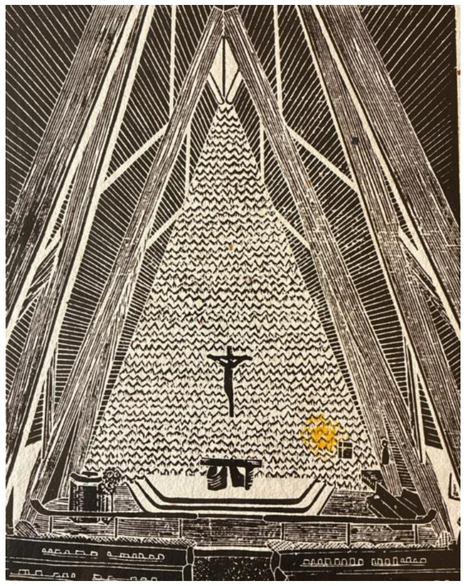
The Organist’s View, by Heidi McElrath
All things came into being through him, and without him not one thing came into being. What has come into being in him was life, and the life was the light of all people.
Perhaps you know this simple scientific fact: that all living organisms - from germs to jellyfish to human beings - are made of the same basic chemical components. But, we ask, where do those building blocks of life come from?
Astronomers at the European Space Agency suggest that the answer is found in the light of the stars. Their research holds that ultraviolet starlight is the key to creating the molecules necessary for the formation of life: the formation of carbon atoms connected to hydrogen, oxygen, nitrogen, and other elements that make your life and mine possible.
Patrick Morris, the director of Infrared Processing at Caltech in Pasadena, writes that “the sun is the driving source of almost all life on Earth. Now, we have learned more recently that starlight drives the formation of chemicals that are precursors to the chemicals” that make our lives possible. Thus, we can say that in the remarkable process of earth’s creation some 4.5 billion years ago and in the subsequent evolution of life on earth, including human life, you and I are dependent upon star light. Indeed we hold in our bodies traces of starlight in the trillions of molecules that make life possible.
Imagine, then, that you and the people gathered around you here as well as your pets, if you have them, as well as your children if you have them, as well as friends, siblings, spouse, and co-workers are bearers of star light, unseen to the human eye yet vibrating within you and them.
But there is more. Since 2006, Dr. Masaki Kobayashi of the Tohoku Institute of Technology in Japan has been photographing the light in human beings and has done so with incredibly sensitive camera technology. What Kobayashi and his colleagues suggest is that virtually all living things – from fireflies to human beings – emit measures of light, of light unseen to the human eye but nonetheless particles of light. This is to say that that you and I glimmer, we glimmer as chemical reactions in our bodies liberate energy, produce heat, and release particles of light: a glow that tends to be strongest in the afternoon and strongest on the face. What comes to my mind is the priestly blessing in the Book of Numbers: “The Lord bless you and keep you; the Lord’s face shine upon you – the Lord’s face shine upon you – and be gracious to you” (Numbers 6:24-25).
It would seem, then, that we and all other creatures, both fauna and flora, are united in our need for light and are united as holders of natural light within us: a network of beings who share in the light of the stars and whose bodies glimmer with particles of light. Is it any wonder, then, that the author of the fourth gospel would say that the creating Word of God has endowed all things with life and with light? Of course, here we move from the natural light accessible through scientific study to light as an image of who we are called to be as disciples of Jesus.
And so I wonder: What does it mean that you and I are children of the light, that we are called to be light in the world? Perhaps it can be helpful to remember that light has always been seen as a sign of God’s presence and God’s unmerited, unconditional, and ever-flowing grace: God’s grace as that photon of light, as that spiritual energy which causes the molecules of our souls to vibrate with energy and radiate outward. To be called light bearers might then suggest that we are called to be gracious toward ourselves and toward others, to let that annoying voice of negative judgment about ourselves or others, that voice we sometimes hear within ourselves, take a rest or just go silent.
To be bearers of the light might mean that we recognize our capacity to enliven, why even to excite the particles of light, of grace, of graciousness, in others. For, as you must know, light is a radiating power that begs to be shared in order to make life possible. Imagine that as your purpose in life: to look for the particles of light, of grace, of graciousness in others and support them.
Or this: to be light bearers in a world frequently marked by conspiracy theories, rejection of science, and untold waves of misinformation filtering through the internet, might well mean that we are committed to the work of enlightenment, of seeking the truth and telling the truth even when it is hard to hear or might get us in trouble. As Anglicans, we are quick to say that God’s gift of reason to each of us is an enlightening ability intended to support and enrich life rather than diminish or degrade it.
To speak then of light and imagine that we are children of the light is no dopey New Age trend that places my sweet bliss, your sweet bliss at the center of the world. When, in this place, we hear in the baptismal liturgy that we are called to let our light shine before others, that call comes to us from the flesh-and-blood Jesus whose “light” was expressed in what? Why in caring for the sick, in releasing people from tormenting spirits, in welcoming so-called social outcasts, in forgiving others, in refusing to retaliate when harmed, in God’s alliance with the poor, in eating and drinking and thus sharing life with those considered by one’s culture or peers to be undesirable table companions. That is, his light radiated an energy that gave others hope. I wonder: should it be any different for us?
The interesting thing about light particles is that, in and of themselves, they don’t make any sound. However, when heated even slightly and expanded in material such a wood or metal or a human body, light particles generate sound waves. That is, light can become sound, photons become phonons. And when warmed and expanded in an enclosed space such as this, we can say that we are literally being showered with musical light, photons transformed by chant, hymn, canticle, anthem, bell, and organ. Imagine, then, that if we had the highly sensitive camera technology of Dr. Kobayashi, we would see glimmering, sparkling waves of light emanating from the loft as we sing that great hymn of praise, the Sanctus, with angels and archangels and all the host of heaven, with our beloved dead who are eternally alive to God and join us in that chorus of thanksgiving.
And so, I say: come to this eucharistic table where the creating Word of God continues to share that radiant energy with you and me; where his generosity is for our good and the good of the world in which live. Dear friends, we are small in number and yet each of us can be a light within this city, a light that shines and sings brightly amid the darkness. After all, what good is light unless it is shared?